
Hyperfocus Is a Superpower — Until It Isn’t: How to Work With It
You sat down to look at one thing.
That was — you check the clock and feel a small jolt — six hours ago. The tea beside you is cold. Your legs have opinions. You are, apparently, extremely hungry, and several people have texted, and the afternoon you had plans for has quietly left the building.
And here’s the complicated part: those six hours felt incredible.
That’s ADHD hyperfocus. If you have an ADHD or AuDHD brain, you’ve likely lived some version of this scene many times — the deep, locked-in state where interest takes the wheel and time stops being real. People love to call it a superpower, and they’re not entirely wrong. They’re just leaving out the invoice.
ADHD Hyperfocus vs. Flow: Not the Same Creature
Flow — the state athletes and artists chase — is deep absorption with the door left open. You surface when you need water. You notice the time, roughly. You chose the task, and you can choose to stop.
Hyperfocus is deep absorption with the door welded shut. It picks the task based on interest, not importance — which is why it happily arrives for a video game or a research rabbit hole and skips the report due Friday. Signals like hunger, thirst, and bladder get filed under “later.” Stopping doesn’t feel difficult so much as not available.
Same neighborhood, different building. Flow tends to leave you energized. Hyperfocus often leaves you blinking in the wreckage of your basic needs, wondering why you feel simultaneously accomplished and terrible.
Why Stopping Is So Hard (It’s Not Discipline)
ADHD brains run on an interest-based nervous system — attention flows toward what’s novel, urgent, or fascinating, not what’s officially important. When something finally lights up that system, the brain gets a steady drip of the engagement it’s usually rationing. Letting go of that mid-stream is genuinely, neurologically hard.
So the six hours weren’t a lapse of willpower. They were your attention system doing the thing it does best, with nobody at the exits. The kind move isn’t to scold the system — it’s to staff the exits.
The Signals You’re Depleting (Your Body Files Reports)
Even mid-lock, the body sends updates. They’re just easy to miss until they’re loud. Some common ones, in escalating order: dry mouth and a headache arriving from nowhere. Eyes that sting or blur. A bladder situation you’ve been negotiating with for an hour. Shoulders up near your ears, jaw tight. Irritability at anything that interrupts — a person, a notification, a doorbell. And afterward: the crash. Shaky, hollowed-out, oddly emotional.
If the crash keeps surprising you, that’s not obliviousness — interoception (reading your body’s internal signals) is often quieter in ND brains. The signals were sent. The inbox was just muted. External cues can carry what internal ones drop. Coming Home to Your Body: A Gentle 5-Minute Guide to Presence has more on rebuilding that connection between body and awareness.
When Hyperfocus Picks the Wrong Target
Here’s the part that stings most: hyperfocus doesn’t consult your priorities before choosing where to land. It will happily lock onto reorganizing a spreadsheet of books you own while an actual work deadline sits untouched two tabs over. It will pour six hours into a hobby project the night before a big meeting. This isn’t a character flaw or a sign you don’t care about the important thing — the system that selects targets runs on novelty and interest, and importance simply isn’t a variable it weighs.
Knowing this in advance changes how you can respond to it. Instead of fighting the mismatch after it’s happened — the frustrated why did I spend all night on that instead of the report — it helps to notice the pull early and make a conscious trade: “I can feel this wanting to take over. Let me give it twenty minutes, deliberately, and then redirect toward the thing that actually needs me today.”
Sometimes that redirect works. Sometimes hyperfocus simply wins anyway, and the kinder response is damage control rather than self-blame: what’s the smallest version of the important task that can still happen tonight, and can the rest wait until tomorrow with less catastrophizing than it currently feels like it deserves.
Aiming Hyperfocus on Purpose
Because hyperfocus is largely involuntary, it can feel like something that happens to you rather than something you have any say in. There’s a middle ground worth knowing about: you can’t force it to arrive, but you can sometimes increase the odds it lands somewhere useful by deliberately pairing a task you need to do with the ingredients that tend to trigger it — novelty, a bit of built-in interest, a clear and immediate feedback loop.
A dull task made slightly novel (new environment, new tool, a self-imposed challenge) sometimes catches the same current that a video game does. This doesn’t work every time — hyperfocus can’t be summoned reliably, and treating it as a productivity trick to master will only add pressure to something that’s fundamentally unpredictable. But on the occasions it does cooperate, redirecting a task you were dreading into one your brain briefly finds fascinating is one of the more satisfying tricks ND brains have available to them.
Building Soft Exit Ramps
The goal isn’t to stop hyperfocusing. Good luck anyway — it’s wired in, and honestly, it’s one of the more remarkable things your brain does. The goal is to make the state survivable: entrances on purpose, exits that exist.
Before you drop in (when you feel the pull starting): water within reach, a snack beside it, bathroom first. Ninety seconds of setup, hours of coverage. If something has a hard deadline today, one sticky note where your eyes will land: “3pm — leave for school run.”
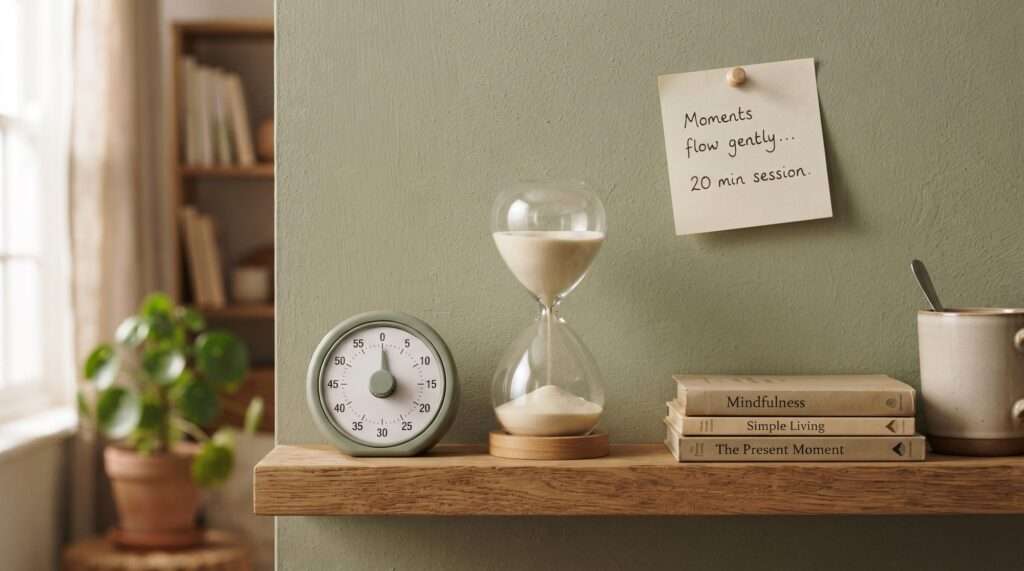
During: alarms, but make them kind. Not one alarm — a series, spaced, with labels that talk to you (“drink the water,” “stand up, you magnificent creature,” “checkpoint: still the right task?”). A body-double or nearby human who’s agreed to gently wave at a set time works even better; brains that ignore clocks often still respond to faces.
The exit itself: leave a note for re-entry — one line about where you stopped and what’s next. Half the resistance to stopping is the fear of losing the thread; the note holds the thread so your body can go eat.
After: the landing matters. Water, food, a few minutes of something undemanding. The crash is smaller when it’s caught early and fed.
A Few Micro-Steps (Pick One, Not All)
- Put a full water bottle at your workspace tonight, so it’s already there when tomorrow’s lock-in happens.
- Set one recurring labeled alarm for your most common hyperfocus window.
- Write your re-entry note template now: “Stopped at ___. Next: ___.” Tape it somewhere obvious.
- After your next session, jot the first body signal you remember ignoring. Just the first one. That’s your early-warning light.
What This Does to the People Around You
Hyperfocus doesn’t only cost the person experiencing it — it ripples outward to whoever’s waiting on the other side of an unanswered text, a missed pickup time, a canceled plan that was genuinely, sincerely meant when it was made. This is worth naming honestly rather than glossing over, because the guilt that follows is real and the people affected deserve more than a vague apology.
What tends to help isn’t promising it won’t happen again — that promise usually can’t be kept, and making it sets up the next lapse as a broken word rather than a known pattern. What helps more is transparency in advance: telling people who share your life how hyperfocus works for you, so a missed message reads as “known wiring issue” instead of “they don’t prioritize me.”
A shared understanding, plus a genuine effort at the exit-ramp systems above, tends to rebuild trust faster than apologies alone ever could. Most people can hold a lot of grace for a pattern they understand and see you actively working with. On the days the crash wins anyway, When the Day Goes Sideways and You Have Nothing Left is a soft place to land.
The Guilt That Shows Up Afterward
Even with every safeguard in place, the crash afterward often comes bundled with guilt — for the missed call, the cold dinner, the hours that vanished from a day you’d planned differently. That guilt deserves a gentle response, not agreement. The six hours weren’t a moral failure. They were a neurological event, the same category of thing as a sneeze or a yawn, just longer and with more consequences attached.
It can help to have a short, honest phrase ready for these moments — something to say to yourself instead of spiraling: “My attention system did what it does. I’m handling the aftermath now, not punishing myself for the cause.”
The aftermath — the apology text, the missed task rescheduled, the water finally drunk — is the part actually within your control. Spend the energy there instead of on relitigating something that was never a choice to begin with. Self-Compassion Prompts: 5 Ways to Be Kind on Hard Days has more language for the moments the guilt is louder than this.
Working With, Not Against
Hyperfocus built things you’re proud of. It’s also eaten days you wanted back. Both are true, and neither cancels the other — it was never a superpower or a flaw. It’s a strong current, and currents aren’t good or bad. They’re just powerful, and worth respecting, and easier to travel with a life vest on.
A question to sit with, if you’d like one: What would it look like to enter the current on purpose — needs met, exits marked — instead of being swept in?
And if a small companion would help, the Permission to Pause card deck — forty gentle prompts for the moments when stopping feels impossible — lives quietly in the Etsy and on Gumroad. No pressure and no timeline attached — it’ll be there whenever you’re ready.