
In a world that celebrates being constantly available and answering with an infinite number of “yeses,” saying no can feel almost radical. But gentle boundaries are one of the more quietly powerful acts of self-kindness available to us. This isn’t about putting up walls or distancing ourselves from people. It’s about creating space for our energy, our peace, and the parts of us that need room to breathe.
There’s a common, unspoken belief that kindness means putting everyone else first, even when it costs us ourselves. I’ve felt the particular exhaustion that comes from this — a tightness that isn’t really about the task itself, more about the small erosion of having said yes when everything in me wanted to say no. Left unchecked, this breeds quiet resentment and slowly mutes our own voice. Gentle boundaries interrupt that pattern. They’re an act of kindness toward ourselves that, in turn, lets us show up more fully for the people we care about.
Why Gentle Boundaries Matter for Inner Peace
Gentle boundaries are like soft borders in a garden — they protect what’s precious without shutting anything out. When we say no to what’s draining us, we’re saying yes to what replenishes us: rest, reflection, creativity, or simply stillness.
A few signs that your boundaries might need some attention:
- Feeling resentful toward people you said yes to
- Consistently prioritizing everyone else’s needs over your own
- Physical tension — tight shoulders, shallow breathing — that shows up specifically around certain people or situations
- A sense that your days don’t quite belong to you anymore
Noticing these signs isn’t selfish. It’s listening to your own inner world closely enough to respond to it. A gentle boundary might sound like: “Thank you for inviting me, but I need this time for myself.”
Practicing Gentle Boundaries in Everyday Life
The beauty of gentle boundaries is their softness. They don’t have to cut you off from people you love — they can actually help preserve the connection, by keeping you from running dry in the process of maintaining it.
Soften your language. Phrases like “Thank you for thinking of me, but I’m not able to take that on right now” or “I’d love to connect soon — let’s find a time that feels calm for both of us” hold the boundary without severing the warmth.
Start small and private. Practice quiet, low-stakes nos first — declining an extra task, not checking email after a certain hour, letting a message wait until tomorrow. These small moments build a kind of confidence that’s hard to access all at once.
Protect your energy cycles. Notice when you tend to feel most alive — morning, evening, somewhere in between — and gently guard that window rather than giving it away by default.
Let go of needing to justify. A boundary doesn’t require a full explanation to be valid. A simple, honest no is often enough.
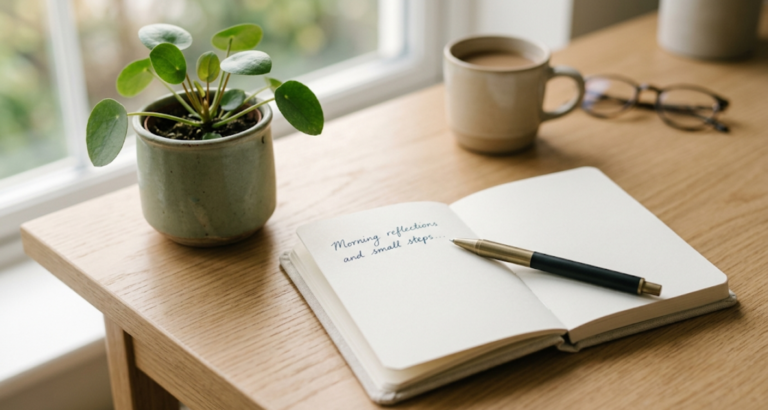
Reflect through journaling. Writing through your boundaries — where they’re thin, where they’re holding — tends to build a clearer, steadier relationship with your own needs than trying to track it all in your head.
Journaling Prompts to Cultivate Gentle Boundaries
A few starting points, if journaling feels like the right way in:
- What one “yes” this week actually felt like a hidden no to myself?
- Recall a time saying no (or wishing I had) led to more peace afterward.
- What are three things I could softly release this month to make more room for peace?
- What does honoring my energy look like on a typical day — and what boundary would support that?
- Write a note to myself with kindness for the moments boundaries feel uncomfortable.
- Who or what drains my peace the most, and what could I say to protect it?
- Recall a time someone honored my boundary. What did that feel like?
- What self-care is waiting for me once more space opens up?
These prompts aren’t meant to produce dramatic insight in one sitting. They’re meant to build a slow, cumulative trust in your own voice.
The Ripple Effect of Self-Kindness
The more you practice gentle boundaries, the more the rest of life tends to soften around them. Presence comes more easily. Conversations go deeper because your yeses are more genuine. In my own routine, this kind of reflection usually comes with a cup of tea gone slightly lukewarm and softer lighting than I use for anything else in the day — a small signal to myself that this particular time is protected.
You don’t have to be perfect at this. Some days boundaries come easily; other days they take real courage. Either way, the practice is the same: gentleness with others, and just as much — maybe more — with yourself.
Boundaries aren’t obstacles to love. They’re the ground it actually gets to grow in. By saying no with kindness, you’re saying yes to a more honest, more sustainable version of your own life.
If This Found You Gently
If this feels like something worth sitting with a little longer, the Permission to Pause Cards hold more prompts for slowing down without guilt.