There are days when you open your journal and the blank page feels less like an invitation and more like a test. The voice in your head begins its quiet inventory: You’re supposed to write more than this. You’re supposed to go deeper. You’re supposed to fill at least one full page if you’re going to bother at all. Before you’ve even put pen to paper, the practice already feels like something you’re failing at.
If that familiar tightness rises in your chest when you think about journaling, you are not alone. Many of us carry an unspoken belief that meaningful writing has to be substantial — that a “real” journaling practice looks like long, flowing entries or pages filled with insight every single day. Anything less starts to feel like not trying hard enough.
But what if the opposite is true? What if the very thing that makes journaling nourishing is its smallness? What if one page — or even a few honest lines — is not a lesser version of the practice, but the version that actually has room to breathe?
The Hidden Weight of “More”
We rarely talk about the quiet pressure that creeps into practices meant to bring us peace. Somewhere along the way, journaling became another place where more felt like better. More pages. More consistency. More depth. More proof that we are doing the inner work correctly.
On hard days or low-energy days, that expectation becomes its own kind of exhaustion. You open the notebook, stare at the lines, and feel the weight of everything you “supposed” to be processing or releasing or understanding. The page stops being a place to land and starts feeling like another obligation on an already full day.
The nervous system notices. It registers the journal not as a soft companion but as another demand. And so the practice that was meant to offer relief begins to create the very tension it was supposed to ease.
What One Page Can Actually Hold
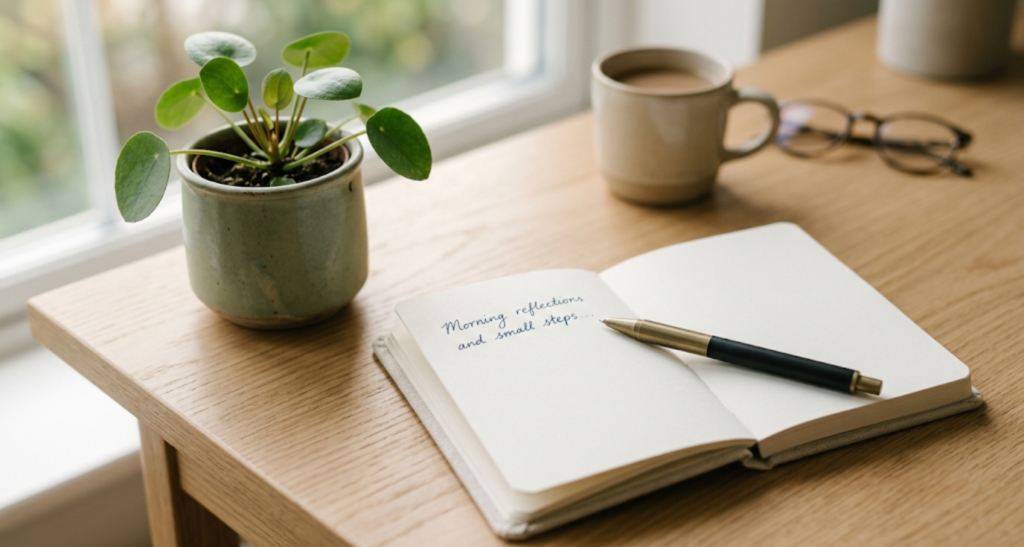
One page does not have to contain profound realizations or neatly tied-up emotions. It can hold the smallest things: the way the light looked through the window this morning, the sound of rain on the roof, the single sentence that kept circling in your mind all day.
It can hold a question you don’t know how to answer yet. It can hold the admission that today was simply hard and you don’t have words for why. It can hold nothing but the date and a deep breath you finally remembered to take.
When we stop requiring the page to perform, it becomes free to simply receive whatever is true. And in that receiving, something shifts. The writing stops being a task and becomes a quiet act of staying with yourself. One page becomes a place where you are allowed to be exactly as you are — tired, scattered, tender, or numb — without needing to make it beautiful or useful first.
How Less Creates More Room for Peace
There is a particular kind of peace that arrives when we give ourselves permission to do less. It is not the peace of having accomplished something impressive. It is the peace of having removed one more silent demand from an already demanding day.
When the practice shrinks to one page, the nervous system can stay regulated. There is no race to fill space. There is no inner critic waiting to judge the quality or quantity of what appears. There is only the simple question: What wants to be written today, if anything at all?
Some days the answer may be a few sentences. Some days it may be a single word or a small drawing in the margin. Some days the page may stay mostly blank because the truest thing you needed was simply to sit with the notebook open and let your shoulders drop. All of these are valid. All of these are the practice.
The beauty of one page is that it leaves room for the rest of your life. It does not ask you to turn away from the people or responsibilities that need you. It does not require you to carve out twenty or thirty minutes you do not have. It simply asks for a small moment of presence — and then lets you return to whatever the day holds.
The Freedom to Let It Be Uneven
Real life is uneven. Energy rises and falls. Some seasons ask more of us than others. A journaling practice that insists on the same output every day cannot survive the natural rhythms of a sensitive nervous system or a full human life.
One page a day honors those rhythms. It makes space for the days when you write three pages because the words are flowing and the days when you write three lines because that is all your body has to give. It removes the all-or-nothing trap that so often leads people to abandon the practice altogether.
You do not have to earn your right to a smaller page. You do not have to apologize for days when the writing feels ordinary or sparse. The page does not keep score. It simply waits, open and unjudging, ready to receive whatever you bring — or ready to receive nothing at all if that is what today requires.
In the end, the power of one page is not that it is small. The power is that it is sustainable. It is kind. It is a practice you can return to on the hardest days without it asking more of you than you have to give. And sometimes, that is the most peaceful thing of all.
If This Found You Gently
If something here landed softly, you might like what lives in the Eden’s Corner shop on Etsy or Gumroad— gentle prompts and printable pages made for exactly the kind of days that brought you here.
You don’t have to do anything with this. Just notice if it lands somewhere tender.