Hydration as Self-Care: Making Water Rituals Beautiful
Of all the wellness advice in the world, “drink more water” is the one nobody argues with and almost nobody follows. This post treats hydration as self-care rather than another rule to follow.
It’s not that we don’t believe it. It’s that it’s boring. Water has no flavor arc, no ritual, no moment. It’s a chore dressed as health — a checkbox that eight-glasses-a-day turned into a tiny daily exam most of us are vaguely failing.
So here’s a different approach entirely: stop trying to be better at drinking water. Make water nicer instead. Because habits don’t run on discipline for long — they run on affection, and affection can be staged. That is what hydration as self-care looks like in practice.
Hydration as Self-Care: Why the Boring Habit Deserves Better Marketing
Quick reminder of what’s on the table, then no more lecturing: mild dehydration shows up as fatigue, headaches, fog, and a shortened fuse long before it registers as thirst. A meaningful slice of ordinary afternoon misery is just a body running dry. Rehydrating is the cheapest mood upgrade available, with the shortest lag time and no downside.
Which raises the actual question — if the payoff is that good, why is the habit so weak? Because it’s been framed as compliance. Nobody loves a compliance task. People love rituals: small, sensory, repeatable moments that feel like theirs. The entire trick of this post is moving water from the first category to the second.
Why Thirst Is a Bad Alarm System
Part of why so many people stay quietly under-hydrated without noticing is that thirst is a surprisingly late and unreliable signal — by the time it registers clearly, a meaningful amount of mild dehydration has usually already happened. For people whose interoception runs quiet (a lot of ND brains included), thirst can arrive even later, sometimes skipping straight past “a little dry” to “sudden headache” with nothing legible in between.
Waiting for thirst to prompt the habit is a little like waiting for the smoke alarm to prompt fire safety — technically a signal, but a late and unpleasant one to build a system around. If body signals tend to arrive late or not at all, Interoception and the ND Body: Learning to Hear What Your Body Is Actually Saying explains why that happens.
This is exactly why staging matters more than willpower here. If the habit depends on noticing an internal cue that arrives inconsistently, it will always feel unreliable. If the habit depends on an external cue — the glass in your line of sight, the kettle going on, the carafe on the desk — it works regardless of how loudly or quietly your body happens to be broadcasting that day. Willpower is an unreliable engine anyway, as Interest-Based Motivation: Why Willpower Doesn’t Work for ADHD Brains explores.
The Vessel Is Half the Ritual
Small truth with outsized returns: you drink more from things you like drinking from. Hydration as self-care starts with the cup you actually reach for.
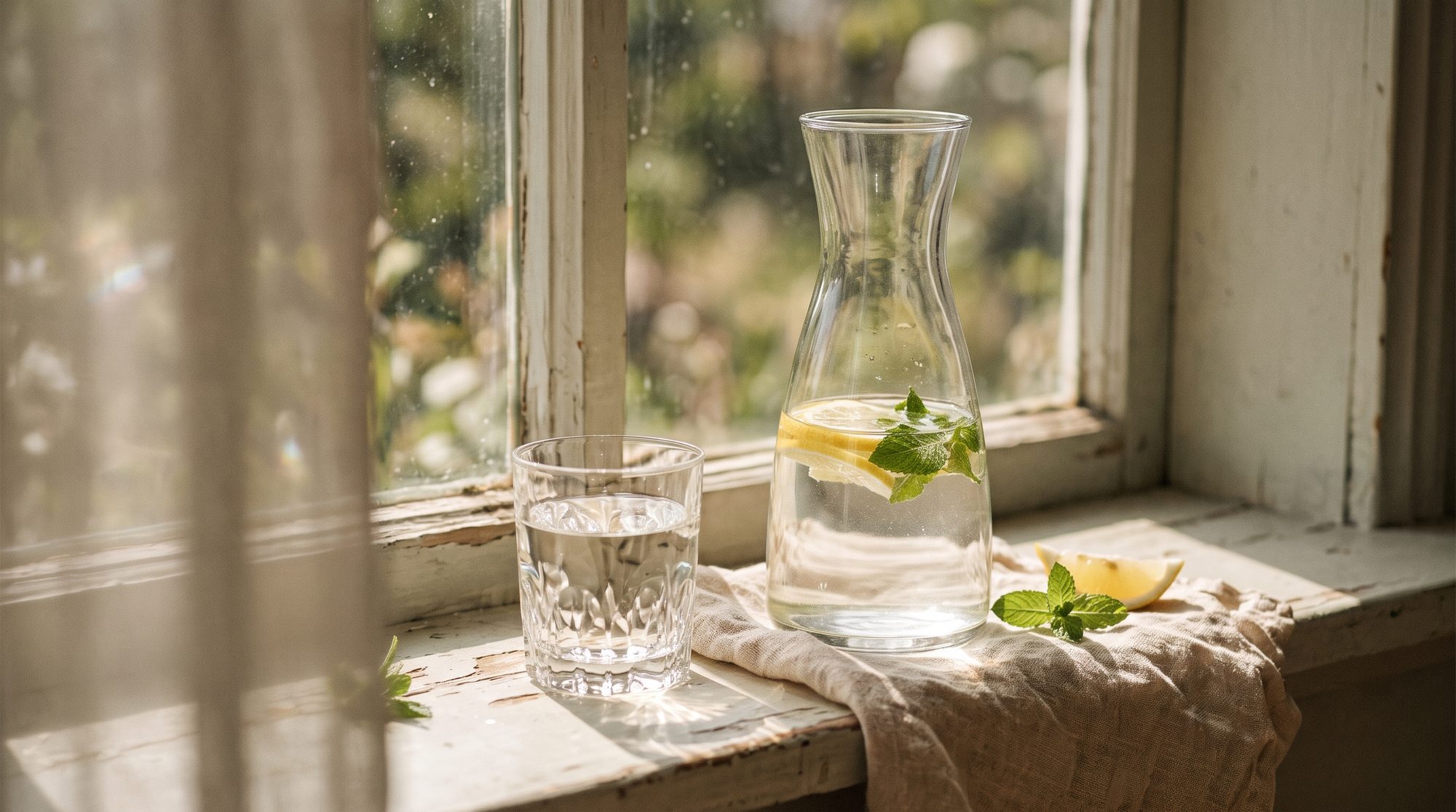
The heavy glass with the good weight. The stoneware mug. The carafe that makes pouring feel like a small ceremony. Whatever your version is — and most homes already own it, buried behind the novelty cups — promote it to daily duty. Water in a beautiful vessel is a different beverage than water in the free conference bottle; the liquid is identical and the experience is not, and the experience is what the habit runs on.
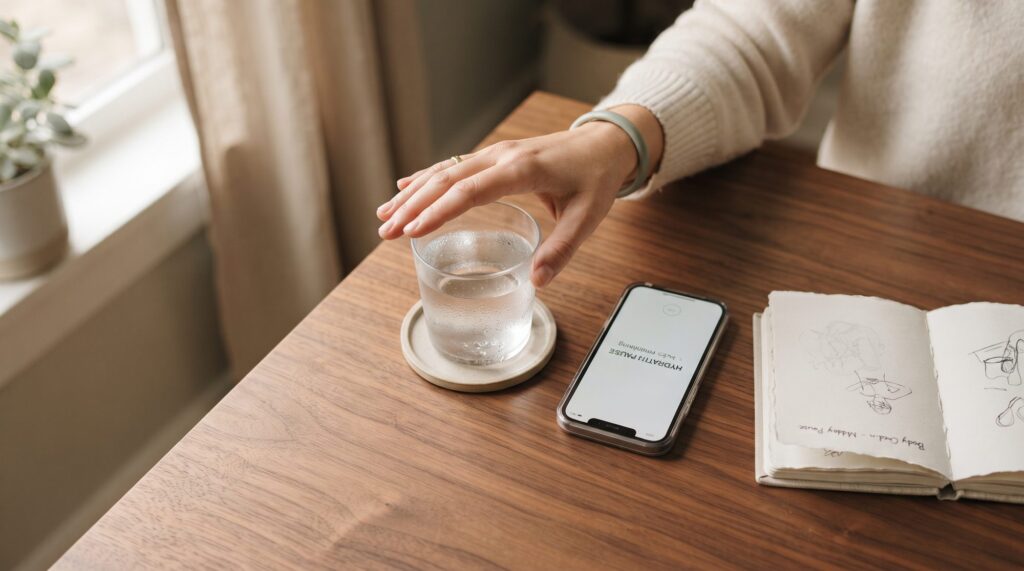
The same goes for staging: a small carafe-and-glass on the desk or nightstand isn’t clutter, it’s an invitation. Refilling it can be its own two-minute ritual — a walk to the tap, a pause, a reset between tasks. Beautiful is doing real work here. It’s the difference between a reminder and a welcome.
Making Water Interesting (It’s Allowed)
Purity rules — it only counts if it’s plain — serve no one. Water is allowed to be delicious: Hydration as self-care can taste like something.
The infusion habit. A few slices of anything — lemon, cucumber, orange, berries — or a sprig of mint or rosemary in the carafe. Thirty seconds of effort, and suddenly the water has a today to it. Seasonal versions keep it quietly interesting: citrus in winter, berries in summer, and yes, this is the moment the pitcher earns its herbs.
The warm flavor. Herbal teas are hydration wearing a cozy outfit. The evening chamomile, the afternoon peppermint — all of it counts fully, and warm drinks come with built-in ritual for free.
The sparkling option. Bubbles count too. If fizz is what makes the glass appealing, the glass has met its requirement.
The first-and-last frame. Two anchor rituals hold the whole day: a glass on waking — before the coffee, as a small good-morning to the body — and something warm and caffeine-free near bed as the closing gesture. Everything between is bonus. The morning glass slots easily into a gentle morning routine.
Attaching It to the Day (No Tracking Apps Required)
Rituals stick by attachment, not by monitoring. A few natural hooks: pour a glass every time the kettle goes on for anything else. One glass per work-block transition — hydration as the doorway ritual between tasks. The 3 p.m. slump gets met with water first, verdicts after. And the visible rule beats every reminder app: where the eyes land, the hand follows, so let the carafe live in the line of sight. Hydration as self-care grows from cues, not tallies.
If tracking genuinely pleases you — some brains love a small ledger — a habit tracker row is a lovely place for it. If tracking makes it homework, skip it forever. The ritual is the point; the count was never the point.
Building a Water Station That Actually Gets Used
A ritual only survives if it’s easier than the alternative, so it’s worth spending five minutes actually designing where and how the water lives in your space, rather than hoping a good intention carries the habit on its own. The single biggest factor is proximity: a glass that requires walking to another room loses to a glass that’s already on the desk, every single time, regardless of how much you meant to drink more this week.
Pick the one or two spots where you spend the most hours — the desk, the nightstand, the spot on the couch — and give each one its own permanent vessel, rather than relying on a single glass that migrates around the house and is never where you are when thirst finally does show up. If out of sight really does mean out of mind for you, Object Permanence and Relationships: When Out of Sight Means Gone will feel familiar.
Refilling deserves its own small design too. A carafe that holds most of a day’s water means fewer trips and less friction than a small glass that empties every twenty minutes; a large glass jar in the fridge door does the same job for cold water. The goal isn’t to engineer perfection — it’s to remove enough friction that the nicer version of the habit doesn’t require more effort than the neglected version did.
What This Looks Like Through a Day
It can help to see the ritual in motion rather than as a list of separate tips. Morning: the first glass poured before coffee, drunk slowly while the kettle heats, a genuinely pleasant minute rather than a chore squeezed in. Midday: the desk carafe refilled during a natural break, a glass poured at the start of each new task as a small doorway ritual. Here is hydration as self-care across one ordinary day.
Afternoon: the 3 p.m. dip met with water before anything else, out of curiosity as much as habit — does some of this fog lift in the next twenty minutes? Evening: something warm and caffeine-free, chamomile or plain hot water with lemon, marking the close of the day the same way the morning glass marked its opening.
None of this requires perfect execution every day to count as working. A day where only the morning glass happens is still a day the ritual showed up, and a day where nothing happens at all doesn’t erase the days that came before it. The point of describing it end to end isn’t to hand you a new checklist — it’s to show how naturally the pieces can attach to a day that’s already happening, once the vessels and the visibility are in place. Hydration as self-care has room for off days.
A Few Situations Worth Naming Directly
Some circumstances change the math on this, and it’s worth saying so plainly rather than pretending one approach fits everyone. Certain medications and medical conditions change fluid needs in ways worth discussing with a doctor rather than guessing at — this post is about making an already-recommended habit more pleasant, not prescribing a specific amount for every body. Caffeine and alcohol both increase fluid needs somewhat, which is one more reason the first-and-last frame works well as a simple anchor rather than a precise calculation.
And for anyone recovering from a strained relationship with food or drink tracking of any kind, skipping the ritual’s optional tracker entirely is not just fine but often the wiser choice — the glass in the beautiful vessel does the real work regardless of whether anything gets logged. For signs that your body needs more than a ritual, MedlinePlus has a clear guide to dehydration.
A Few Micro-Steps (Pick One, Not All)
- Promote your favorite glass to official water duty today.
- Set up one carafe-and-glass station where you actually spend hours.
- Slice one thing into tomorrow’s water and see if it changes the relationship.
- Start the first-and-last frame: one glass at waking, one warm cup near bed.
Affection Over Compliance
You were never bad at hydration. The habit was just packaged as a chore, and chores lose. Give the water a good glass, a slice of something, and a place in the line of sight — and let affection do what discipline kept failing to. Hydration as self-care is simply that habit, given a little more affection.
A question to sit with, if you’d like one: What would make my next glass of water feel less like a checkbox and more like a small kindness — and how fast could I set that up?
And if a small companion would help, the Eden’s Corner shop — gentle prompts and printable tools for days like this — lives quietly on Etsy and Gumroad. No pressure and no timeline attached — it’ll be there whenever you’re ready.