
The Exhaustion of Being Perceived: Navigating a World Built for Neurotypical Brains
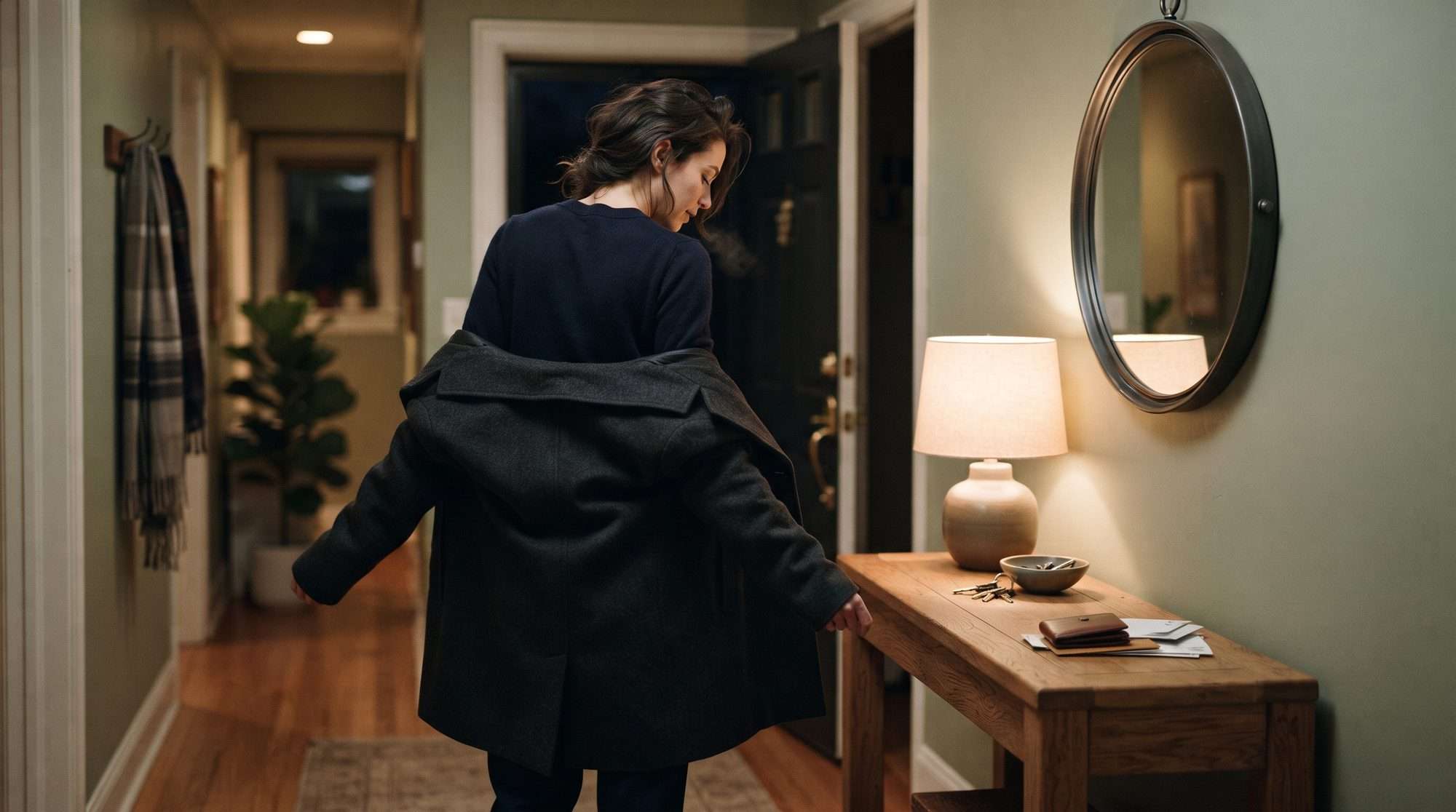
Some evenings you get home, close the door, and feel your whole body exhale — as if you’ve been holding a pose for nine hours.
Because you have.
Not a physical pose. A social one. The right amount of eye contact. The face that signals “listening” in the approved way. The laugh at the correct volume, the small talk performed to spec, the stimming quietly rerouted into a clicked pen — Stimming Is Self-Regulation has more on why that rerouting costs something. None of it was the actual work of the day. All of it was work.
If you’re autistic, ADHD, or AuDHD, this second, invisible workday has probably been running so long it feels like weather — just how life is. It isn’t. It’s labor — a specific, real neurodivergent exhaustion — and naming it as labor is the beginning of getting some of that energy back.
Naming Neurodivergent Exhaustion as Invisible Labor
Neurotypical environments come with a thick book of unwritten rules, and ND people don’t get handed the book — they get handed the consequences of missing it. So the brain compensates by running everything through manual review.
While a neurotypical colleague simply has a conversation, you might be simultaneously: monitoring your face, calibrating your tone, translating their subtext, suppressing the urge to move the way your body wants to move, filtering the sound of two other conversations, and drafting your next sentence in triplicate to make sure it won’t land wrong.
That’s not a conversation. That’s air traffic control. And it runs on top of your actual job, errands, and relationships — which is why “but everyone finds work tiring” has never quite covered it. Everyone carries the day. Not everyone carries the day plus a full-time translation service.
Passing Has a Price Tag
Masking works, which is exactly the problem. Do it well enough, for long enough, and everyone around you gets comfortable with a version of you that costs you something to produce.
The bill arrives privately. The post-work shutdowns. The weekends spent recovering rather than living. The strange loneliness of being liked as someone slightly other than yourself. Research on autistic adults keeps linking long-term masking to anxiety, depression, and burnout — a finding that surprises approximately zero people who’ve lived it.
And because the performance is invisible, the exhaustion looks unearned from the outside. “But you seemed fine at the meeting.” Yes. Seeming fine was the expensive part.
What the Body Keeps Score Of
The invisible labor doesn’t stay invisible forever — it shows up somewhere, usually the body, usually after the fact. A headache that arrives an hour after a long meeting. A stomach that won’t settle after a day of small talk. The particular flatness of a Sunday spent recovering from a Friday that looked, from the outside, like nothing more than “a normal week.”
This is the nervous system billing you retroactively for a day of constant micro-adjustment. Vigilance has a metabolic cost — literally, measurably — and a body that’s been running threat-detection and social-translation simultaneously for nine hours doesn’t just clock out clean at five. It needs actual recovery time, the way a muscle needs rest after exertion, not because you’re fragile but because you did real physiological work.
Recognizing this pattern matters because it reframes what “self-care” needs to mean on those days. It isn’t a bath or a treat — it’s decompression, the same category of need as an athlete stretching after a race. Quiet, low sensory input, permission to not perform for a while. The body isn’t being dramatic. It’s presenting an invoice for services rendered. On the days that invoice comes due all at once, When the Day Goes Sideways and You Have Nothing Left is a soft place to land.
The Specific Exhaustion of Being Watched
There’s a layer to this worth naming on its own: the felt sense of being observed, even in ordinary moments — a coworker glancing over, a stranger’s gaze in a checkout line, a video call where your own face stares back at you the whole meeting. For many ND people, that felt observation triggers a low-grade performance response almost automatically, whether or not anyone is actually paying attention.
This isn’t paranoia; it’s a learned pattern from a lifetime of being visibly different in ways that drew comment, correction, or stares — the flapping hand redirected, the loud reaction shushed, the “too much” delivered as feedback often enough that a scanning-for-audience habit took root. The exhaustion of being perceived, then, isn’t only about the effort of masking. It’s also the baseline tax of assuming, correctly or not, that someone is always grading the performance.
Small counters exist. Turning off self-view on video calls removes one mirror. Sitting with your back to a wall in public spaces, where fewer people are behind you, can lower the felt surveillance by a surprising amount. None of these resolves the underlying pattern, but they do lower the hourly cost while you’re living inside it.
The Grief and the Anger Are Allowed
Somewhere in understanding all this, feelings tend to show up that don’t fit on a gratitude list.
Grief — for the years spent believing you were just bad at being a person, when you were actually excellent at an impossible assignment. Anger — at schools, workplaces, and systems that treated your wiring as a defect to be sanded down rather than a difference to be accommodated. Maybe both at once, taking turns.
Those feelings are proportionate. You don’t have to talk yourself out of them or rush them toward acceptance on a schedule. A world genuinely wasn’t built with your brain in mind, and noticing that honestly is not bitterness — it’s accuracy. What you do next gets to be gentle, but the noticing is allowed to be sharp. Self-Compassion Prompts: 5 Ways to Be Kind on Hard Days has more language for holding the grief and the anger both.
Building a Life That Asks Less Performing
Unmasking entirely, everywhere, isn’t realistic for most people — jobs, safety, and family dynamics are real constraints. The workable question is smaller: where can the mask come off, or at least loosen?
A few places to look. At home, alone: does the mask still run even with no audience? (For many of us, yes — worth noticing.) With your safest one or two people: what would it be like to move, speak, or go quiet the way your body actually wants to, on purpose, for ten minutes? In your environment: how much performance could you subtract with earplugs, sunglasses, a camera-off meeting, a text instead of a call? Each subtraction is energy returned.
And finding your people matters more than any technique. Time with other ND folks — where the eye contact rules dissolve and info-dumping is a love language — is often the first place the exhaustion visibly drops. It’s not that those rooms have no rules. It’s that the rules finally fit.
Naming It to the Right People
Part of what makes this exhaustion so isolating is that it rarely gets named out loud — not because people wouldn’t understand, but because the moment to explain it never quite arrives. A short, low-stakes way to introduce the concept to a partner, friend, or manager: “I’m not tired from the tasks today, I’m tired from managing how I came across while doing them. That’s a real, separate kind of tired, and it doesn’t always show up until later.”
You don’t owe anyone a full account of masking theory to be believed. Most people, once they hear the distinction between task-tired and performance-tired, recognize a version of it in themselves too — just usually at a smaller volume. That shared recognition, even partial, is often enough to make room for what you actually need afterward: quiet, fewer demands, no follow-up questions about why you seem “off.”
A Few Micro-Steps (Pick One, Not All)
- Tonight, notice one masking behavior that’s still running when you’re alone. Just notice it. No assignment attached.
- Choose one low-stakes subtraction this week: camera off, earplugs in, one call converted to a text.
- With your safest person, let one small real thing through — the honest “actually, I’m fried,” the fidget unhidden.
- If you know another ND human, send the meme. That’s community-building. It counts.
A Few Journal Prompts for the Exhaustion
Writing it down can make the invisible labor visible, which is often the first relief on its own:
- What did I perform today that no one asked me to perform, and what would it look like to skip it once?
- Where in my body did today’s effort land — and what does that part of me need tonight?
- What’s one place, however small, where I already get to exist without translation?
The Exhale
You are not exhausted because you’re weak. You’re exhausted because you’ve been doing two jobs and getting credit for one.
A question to sit with, if you’d like one: Where in my life do I already exhale — and what’s one small way to spend more time there?
And if a small companion would help, the Permission to Pause card deck — forty gentle prompts for setting the performance down — lives quietly in the Etsy and on Gumroad. No pressure and no timeline attached — it’ll be there whenever you’re ready.