Creating a Sacred Space at Home for Daily Calm
Somewhere in your home, there’s a spot where you could create a calm space at home without a renovation or a spare room.
Not a whole room — this isn’t that kind of article. A corner. A chair by a window. The end of a hallway nobody uses, a windowsill, the left side of the bedroom where the light lands in the afternoon. A few square feet that could belong, officially and entirely, to the quiet version of you.
That’s all a sacred space is: a small territory in your home where nothing is demanded of you, and where a few chosen things help your body remember how to settle. No renovation required, no aesthetic standards to meet, and “sacred” means whatever it means to you — spiritual, secular, or simply mine.
Why a Dedicated Spot Works (It’s Not Superstition)
Environments cue nervous systems. The desk cues work-mode; the kitchen doorway cues snack inventory; the couch cues the scroll. Your body reads rooms and responds before you’ve had a single conscious thought about it.
A sacred space uses that same machinery on purpose. When one physical spot is used only for calm — sitting, breathing, journaling, tea, prayer, nothing at all — the body starts associating the location with settling. After a few weeks, simply arriving there begins the exhale. You’ve built a light switch for your nervous system, made of geography. When Your Nervous System Is Fried: A No-Pressure Guide to Regulation Without a To-Do List has more on what that settling can look like on the harder days.
This is also why the space works better when it’s not multipurpose. The corner where you also fold laundry and take work calls can’t specialize. Small and single-purpose beats large and shared.
Where to Create a Calm Space at Home
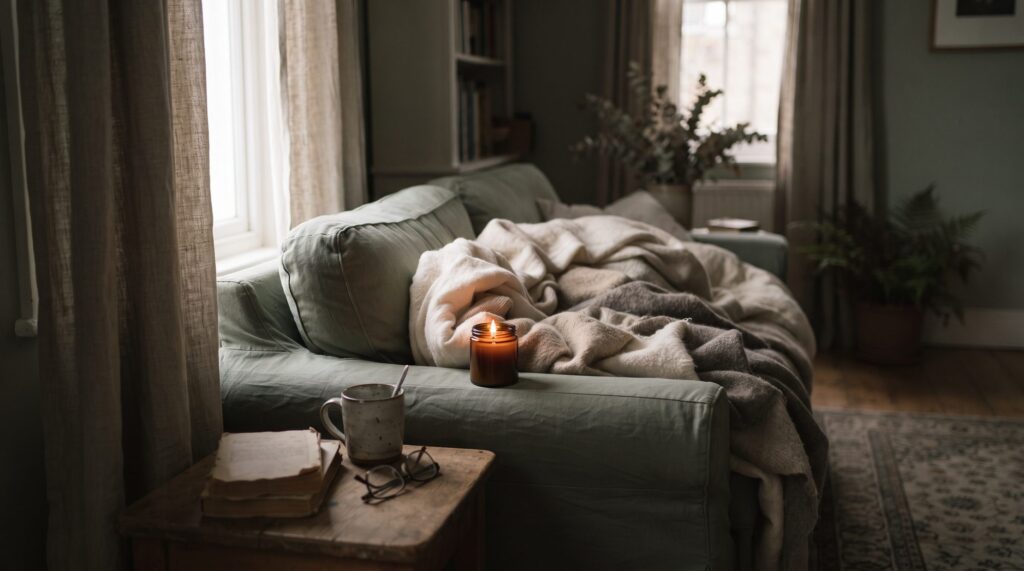
The right spot usually announces itself with one question: where in this home does my body already soften, even slightly? Near the window with the plant. The armchair that faces away from the kitchen chaos. The floor beside the bed, morning light included.
Practical notes: away from the main traffic path if possible; near natural light if you have it; and — this matters more than people expect — positioned so clutter and unfinished tasks aren’t in your direct line of sight. The laundry pile doesn’t need to be gone. It just needs to be behind you.
If you share a small home, the space can be temporary and assembled: a basket holding your candle, blanket, and journal, deployed onto the same chair each evening. The ritual of setting it up becomes part of the settling.
When You Can’t Claim a Permanent Spot
Not everyone has a corner to spare. Studio apartments, shared rooms, dorms, homes with a rotating cast of family members — a permanently dedicated square of floor isn’t always available, and the sacred-space idea can start to feel like one more thing designed for people with more room than you have. The good news: you can still create a calm space at home without a permanent spot.
The workaround is portability. A small basket or bag holding the four objects — candle, natural thing, meaningful thing, soft thing — can turn any chair, any patch of floor, any corner of a shared bed into the space for the ten minutes you’re using it. The ritual of unpacking the basket becomes part of the signal, doing the same job that walking to a set-aside corner would do in a bigger home. Pack it away afterward, and the space returns to being whatever else it needs to be for the rest of the day.
For people sharing a room with a partner or family member, a simple verbal or visual cue — a specific cushion turned a certain way, a whispered “give me ten minutes” — can function as the boundary a closed door would provide elsewhere. The space doesn’t need walls to be respected. It needs a shared understanding that when the cushion is turned, this square of floor is temporarily off-limits to conversation.
What to Do When the Space Stops Feeling Sacred
Occasionally a space that used to work will go flat — you sit down and nothing happens, the usual settling doesn’t arrive, and the corner that once felt reliable now feels like just a corner. This is common and not a sign that the whole idea has stopped working.
A few things to try: change one object. Swap the candle scent, replace the plant, rotate in a different meaningful item. Novelty resets attention in a way sameness sometimes can’t. Alternatively, change the time of day you visit — a morning space used only in the evening, or vice versa, can wake back up simply by meeting you at an hour it isn’t used to. And sometimes the honest answer is that the space needs a rest of its own; skip it for a week, let the absence build a little appetite, and return without expectation.
A Minimal Altar (or Whatever You’d Rather Call It)
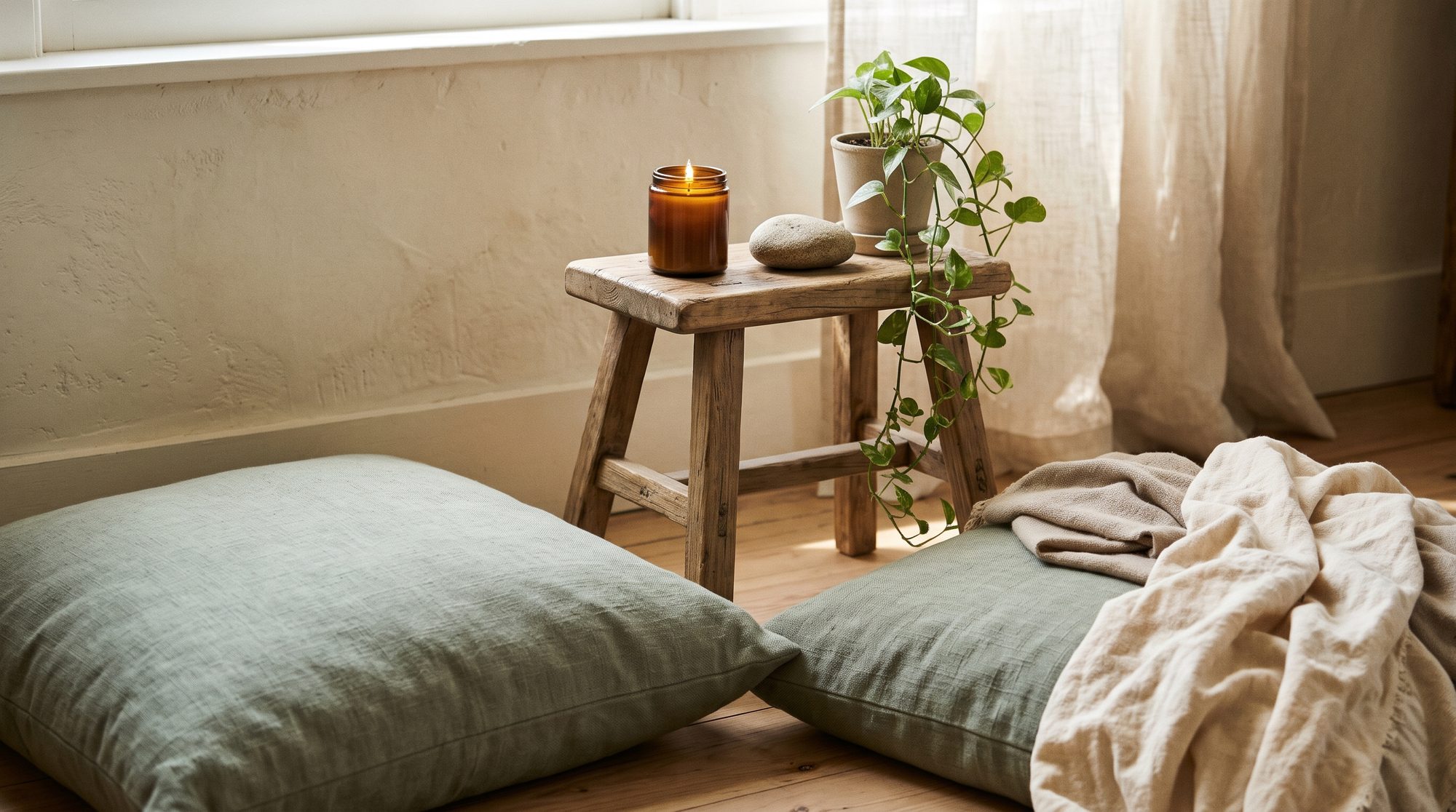
An altar, at its simplest, is a small arrangement of objects that mean something — a visual anchor for the space. Yours might live on a windowsill, a stool, a shelf edge, and it needs very little:
One candle or a small lamp. Light marks the moment — lit means this time is different, blown out means closed. This tiny ritual boundary does surprising work.
One natural thing. A plant, a stone from somewhere that mattered, a branch, a bowl of water. Something alive or elemental for the eyes to rest on.
One meaningful thing. A photo, a token, a small object from a person or season you want near you. (Faceless brand aside — your space is allowed faces.)
One soft thing. A blanket or cushion that lives there, so comfort is pre-installed.
That’s a complete altar: four objects. The restraint is the point — a crowded altar becomes another thing to manage, and this square footage is specifically for not-managing.
Using It (the Two-Minute Standard)
The space earns its keep through small, frequent visits — not long ceremonies. Two minutes with tea before the house wakes. Five slow breaths at the end of the workday, coat still on. A page in a journal, one card drawn from a deck, or simply sitting with the candle lit and letting the eyes unfocus.
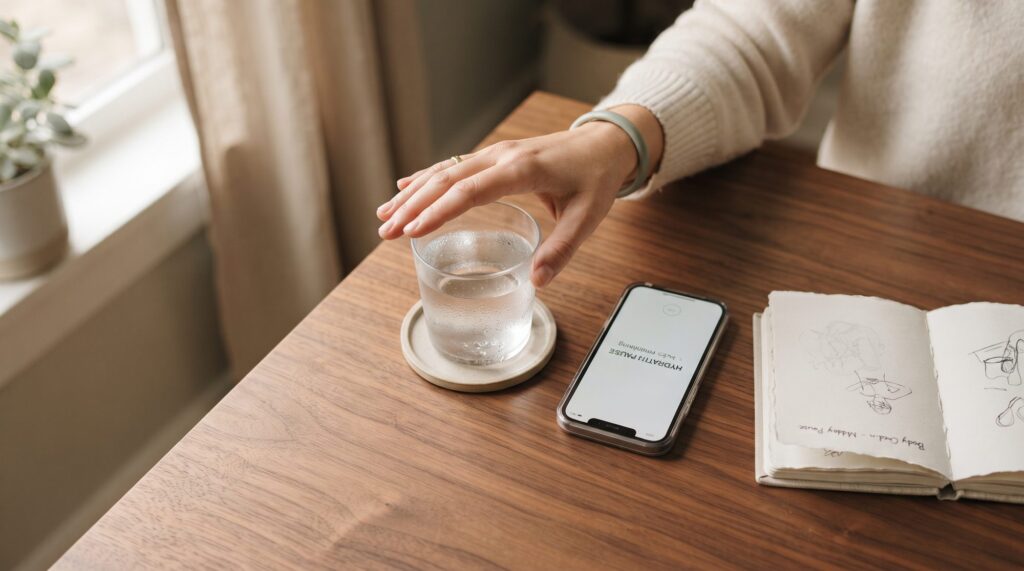
The only real rule: while you’re there, nothing is owed. No phone if you can manage it (the space works best as a scroll-free zone), no sorting out the day, no improving yourself. The spot’s entire job is to be the one place where you’re not a project. If home itself still feels like a stage most of the day, Unmasking at Home: Small Ways to Stop Performing When No One Is Watching pairs well with this.
And when life gets loud and the space goes unused for two weeks — it keeps. Sacred spaces don’t expire, and returning after absence is part of how they work. The candle will still be there.
Sharing the Space (Without Losing What Makes It Work)
Some households want a version of this that includes more than one person — a family calm corner, a shared reading nook, a spot two partners both visit. It’s possible, with one adjustment: shared spaces need slightly more explicit agreement about what happens there, since the whole point is that nothing is demanded of the person using it, and that’s harder to guarantee once more than one person’s needs are in the room.
A simple house agreement covers most of it: whoever is in the space gets to set the terms for those few minutes — silence if they want it, company if they want it, no questions about why afterward. Rotating single-occupant use, rather than assuming shared use always means simultaneous use, tends to preserve the sense of sanctuary better than a corner everyone treats as a general lounge. The space can belong to the household and still, for ten minutes at a time, belong entirely to whoever is sitting in it.
A Few Micro-Steps (Pick One, Not All)
- Walk your home once, slowly, and notice where your body softens. That’s the spot.
- Clear just that surface or corner — nothing else, not the room, just the square.
- Place one candle and one natural thing there tonight.
- Visit for two minutes tomorrow, tea in hand, no agenda.
A Few Prompts to Bring Into the Space
If journaling is part of how you use your corner, a few small prompts sized for two quiet minutes:
- What does this square of space give me permission to set down right now?
- What’s one object here that carries more meaning than its size suggests?
- What would it feel like to visit this spot even on the days I don’t quite believe I’ve earned it?
A Small Territory of Your Own
In a home full of shared spaces and standing obligations, a few square feet that belong only to your quiet is not a luxury. It’s infrastructure. It is the simplest way to create a calm space at home that you will actually use. And if visiting it ever feels undeserved, Rest Is Not a Reward You Have to Earn sits with that a little longer.
A question to sit with, if you’d like one: Where in my home does my body already exhale — and what would it take to make that spot officially mine by the weekend?
And if a small companion would help, the Eden’s Corner shop — gentle prompts and printable tools for days like this — lives quietly on Etsy and Gumroad. No pressure and no timeline attached — it’ll be there whenever you’re ready.