Unmasking at Home: Small Ways to Stop Performing When No One Is Watching
Unmasking at home should be simple: you’re alone, the door is locked, the blinds are drawn, and there’s no audience within a mile.
And you’re still sitting like company’s coming. Still swallowing the hum you felt like humming. Still eating dinner in the “correct” order, holding your face in its public arrangement, narrating your own behavior through an invisible observer’s eyes: is this a weird way to sit? is it strange to rewatch this again?
Weird question to ask an empty room.
If the performance keeps running after the audience leaves, nothing is wrong with you — the mask has simply been on so long it stopped feeling like a mask. It got promoted to “personality.” But underneath, your nervous system is still paying performance rates for an empty theater.
What the Mask Costs (Even Solo)
Masking — suppressing natural movement, mimicking approved expressions, filtering every impulse through how would this look? — is expensive by design. It’s a second job that runs on top of everything else, and its cost shows up as the evening collapse, the weekend recovery, the mysterious exhaustion that rest doesn’t touch.
The solo version is quieter but real: every suppressed stim, every self-surveilling thought, every “correct” posture held for nobody keeps the monitoring system online. The nervous system never gets the all clear, off duty signal — which is the very signal home was supposed to provide.
Why We Mask Alone (It Makes Sense)
This isn’t irrational. If the mask was learned early — through correction, teasing, or the thousand small lessons of “that’s weird, stop” — then masking became a safety behavior, and safety behaviors don’t check whether the threat is currently present. They just run.
Internalized surveillance is the mask’s final form: the external watchers went away, so the brain installed one internally, and it works pro bono, around the clock. Noticing it is not a failure. Noticing it is the beginning of giving it fewer shifts.
The Difference Between Masking and Just Living With Others
It’s worth being precise here, because “unmask completely, always” isn’t actually the goal, and treating it as one can create its own pressure. Everyone — neurodivergent or not — adjusts behavior somewhat around other people; that’s not masking, that’s ordinary social flexibility, and it isn’t inherently costly. Masking specifically refers to suppressing something core about how you naturally move, communicate, or process the world, often for hours at a stretch, often at real physiological cost, often learned under pressure rather than chosen freely.
The distinction matters because it clarifies what home is actually for: not a place where every social skill gets abandoned, but a place where the costly, learned-under-duress suppression gets to stand down. You can still choose to be tidy for a roommate, or quiet at 11pm for a neighbor, without that being masking in the exhausting sense. The target isn’t zero adjustment. It’s zero performance that’s draining you and serving no one.
Permission, Explicitly
Since nobody issued it earlier, here it is now: you’re allowed to move the way your body wants to move. Rock, bounce, pace, flap, hum. You’re allowed to eat the same meal four nights running, in whatever order, at whatever temperature. Rewatch the show for the ninth time. Sit like a gargoyle. Talk to yourself out loud, info-dump to the cat, wear the one texture that feels right regardless of what it “looks like.”
None of that is a lapse. That’s the body, unedited — and at home, unedited is the entire point.
Small Experiments in Being Unwatched
Unmasking isn’t a switch to flip; after years of performance, the bare version can feel exposed, even alone. So go small, like any nervous system work.
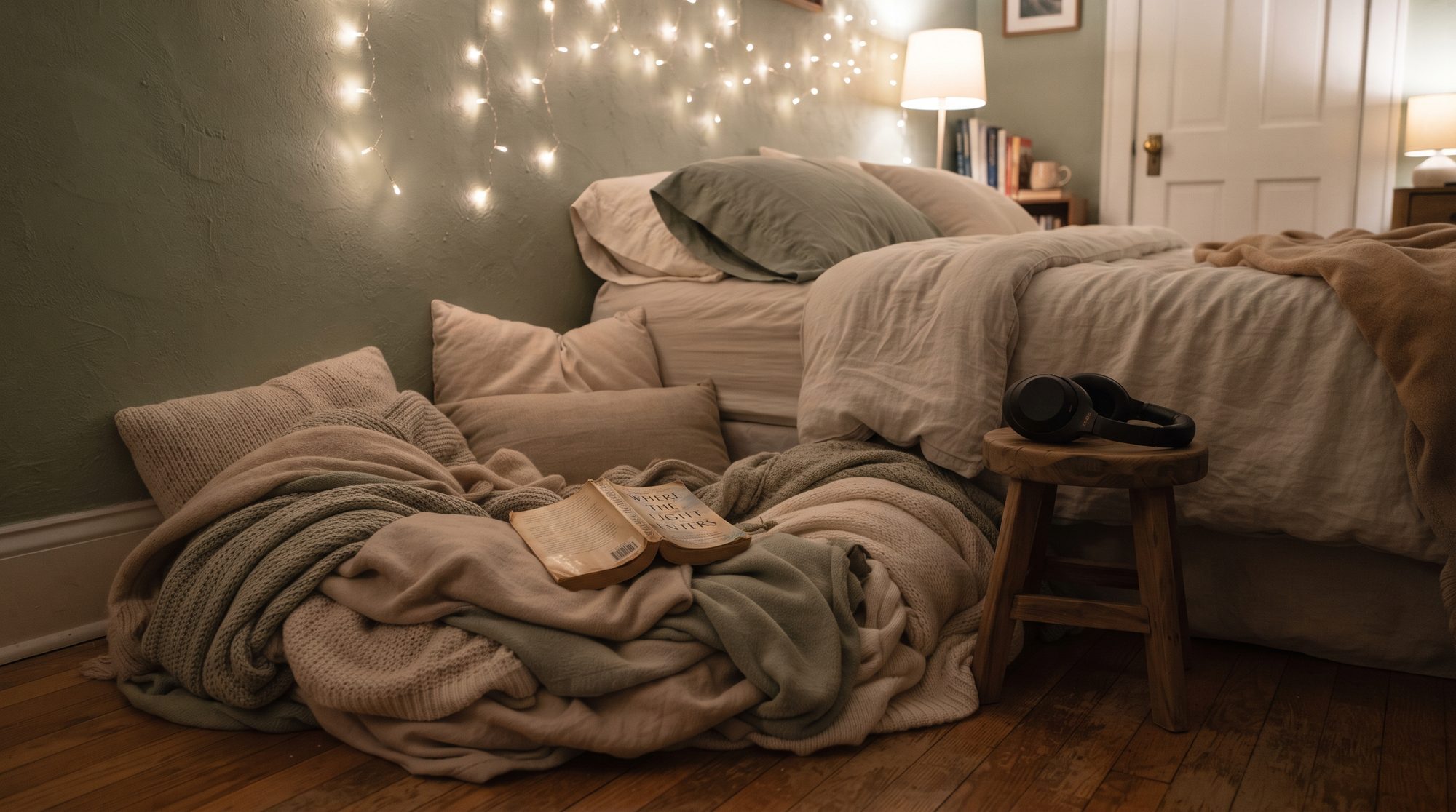
Pick one room. Declare it a no-performance zone — often the bedroom. In that room, deliberately drop one edit: sit however, hum aloud, stim freely. One room, one edit, until it feels boring. Then expand.
Set up the environment to invite it. Dim the harsh lights. Keep the fidget or the soft blanket in reach. Put the comfort show where it’s one click away. Environments cue behavior — build one that cues off duty.
Catch the observer, gently. When the is this weird? narration pipes up in an empty room, try answering it: “No one’s here. This one’s for me.” Not arguing — just updating the surveillance system with current facts.
Re-meet your actual preferences. Long masking can bury the real answers to simple questions. What music do you like — you, not the person you perform? What food, what pace, what bedtime? Treat it as gentle fieldwork: try things, notice the body’s honest yes or no, take notes. Some of your “preferences” will turn out to be costume. Finding out which is quietly thrilling.
Let comfort look however it looks. If your genuine relaxed state is pacing while listening to the same song eleven times, that is relaxation. The picture in the wellness magazines was never the measure.
When Unmasking Feels Harder Than Expected
Some people find, once they finally have the privacy and the permission, that unmasking doesn’t come easily even alone — the body stays braced out of sheer habit, and the freedom feels less like relief and more like standing in an open doorway, unsure how to walk through it. If that’s you, it doesn’t mean the mask is permanent or that something’s gone wrong. It usually just means the mask has been load-bearing for a long time, and load-bearing structures don’t come down the moment they’re no longer needed. They come down in stages, tested a little at a time.
It can help to lower the bar even further than “one room, one edit” suggests. Start with something almost invisible — letting your face rest into whatever expression it wants between tasks, rather than holding a pleasant neutral out of habit. Letting a sigh be audible instead of swallowed. These are tiny, but tiny is exactly the right scale for a system that’s been on high alert for a long time. Bigger unmasking tends to arrive on its own schedule, once the small stuff has proven, repeatedly, that nothing bad happens.
Unmasking Around Pets and Familiar Company
Full solitude isn’t the only setting where unmasking can begin. Pets are an unusually good practice ground — they don’t evaluate, they don’t flinch at stimming, and many genuinely enjoy the version of you that moves and sounds like yourself rather than the polished one. If a pet is in the house, they’ve likely already seen more of the unmasked version than most humans have, simply by being present during the moments the guard drops without anyone deciding to drop it.
The same logic can extend, carefully, to the handful of humans who’ve already proven safe — a partner, a close friend, a sibling who’s never once flinched at the real version. Unmasking doesn’t have to wait for total solitude to start counting. It can begin in the smallest, safest company available, and grow outward from there at whatever pace actually feels sustainable, regardless of what any guide — including this one — suggests as the “right” timeline.
A Few Micro-Steps (Pick One, Not All)
- Tonight, in one room, let one suppressed thing through — the hum, the rock, the weird sit. Just one.
- Notice a single “is this weird?” thought this week and answer it: “This one’s for me.”
- Ask yourself one preference question at dinner: is this what I actually like, or what I perform liking?
- Move one comfort object (blanket, fidget, headphones) to where the evening actually happens.
What to Do With the Grief That Sometimes Shows Up
Unmasking, especially early on, can surface an unexpected feeling: grief, for the years spent performing instead of living, or for the people who only ever met the edited version. That grief is a legitimate response to a real loss, not a detour from the practice. It’s allowed to sit alongside the relief, sometimes in the same evening, sometimes in the same five minutes. Noticing it doesn’t mean something’s gone wrong with the unmasking — it usually means the unmasking is working, surfacing feelings that had nowhere to land while the performance was still running full-time.
The Theater Closes
The mask took years to build, and it did protect you — that deserves acknowledgment, not contempt. But it charges rent, and home is the one place the rent can start coming down. Slowly. One room, one hum, one unedited evening at a time.
A question to sit with, if you’d like one: What did I stop doing, somewhere along the way, that my body still wants to do — and what would it take to let it back in tonight?
And if a small companion would help, the Soft Reset card deck — forty gentle prompts for coming back to yourself on depleted evenings — lives quietly in the Etsy and on Gumroad. No pressure and no timeline attached — it’ll be there whenever you’re ready.