
Seasonal Self-Care: Adjusting Your Routine with Nature’s Rhythm
Every January, a curious thing happens: millions of people design a daily routine in the darkest, coldest, most inward-turned month of the year — and then feel like failures when their July self doesn’t want to live by December’s rules. Or the reverse: the sunrise walks and cold smoothies of summer collapse in November, and it feels like losing discipline.
It was never discipline. It was seasons. Seasonal self-care starts with knowing the difference.
Nothing else in nature runs the same program year-round. Trees don’t push leaves in January and don’t apologize for it. The garden rests, the light shifts, the animals change their hours. Only humans decided the ideal routine is one that ignores all of this — and then blamed themselves when their bodies kept siding with nature.
Seasonal self-care is the simple correction: let the routine change with the light.
The Case for Cyclical Instead of Constant
Your energy genuinely changes with the seasons — light exposure shapes mood, sleep pressure, and appetite in well-documented ways, and most people feel some version of the pull: expansive and social in the long days, slower and more inward in the short ones. For some people the winter dip is more than a mood shift; the National Institute of Mental Health explains the difference in its guide to seasonal affective disorder.
A rigid routine treats those shifts as noise to override. A seasonal one treats them as information. The difference in practice is enormous: instead of one perfect routine failing four times a year, you hold a handful of light, seasonal versions — and each handoff between them is expected, even welcomed, rather than experienced as falling apart.
The routine was never the point anyway. Care was the point. The routine is just the container, and containers can change shape. Seasonal self-care simply lets the container change on purpose.
Why We Fight This So Hard Anyway
If seasonal living is this natural, it’s worth asking why so many of us default to a set, year-round routine and quietly punish ourselves for deviating from it. Part of the answer is cultural: productivity culture runs on the idea of constant, linear output, and a body that wants less in December and more in June doesn’t fit neatly into a calendar built around quarterly goals and identical weeks.
Somewhere along the way, sameness got mistaken for reliability, and reliability got treated as a virtue independent of whether it matches how humans, or any other living thing, actually function.
There’s also a simpler reason: change feels like starting over, and starting over feels effortful in a way that staying the course doesn’t, even when staying the course is quietly costing more. Letting a routine shift with the season means re-deciding things four times a year instead of once — which sounds like more work, until you notice that the “constant” routine was never actually constant. It was just failing quietly instead of changing on purpose, which took its own invisible toll every time you tried to force July habits onto a December body.
Seasonal Self-Care: What Each Season Tends to Ask For
These aren’t rules — they’re the patterns most bodies recognize. Take what matches yours.
Winter asks for less, and earlier. More sleep and permission to want it. Warm food, warm light, smaller social plans. Candles at 4:30 p.m. because the dark arrived and might as well be beautiful. Winter self-care is mostly subtraction — and if your culture’s busiest season (December, ironically) lands here, subtraction matters twice. If resting more brings up guilt, Rest Is Not a Reward You Have to Earn sits with that.
Spring asks for gentle restarts. Energy returns unevenly — bright mornings, tired afternoons. Begin things in small versions: the walk before the running program, the windowsill herbs before the garden. Spring rewards starting soft and forgives false starts; that’s practically its whole personality.
Summer asks to be spent. Long light, higher energy, more yes. The season for people, water, movement, being outside past dinner. Summer self-care often looks the least like “self-care” — it’s mostly joy with the door open. Let it be.
Autumn asks for closing rituals. The natural season of gathering in: finishing projects, making soup, returning to the journal, earlier evenings by degrees. Autumn is the gentle off-ramp toward winter — taking it slowly beats hitting winter at summer speed.
When Your Season Doesn’t Match the Calendar Season
Not everyone’s internal season lines up neatly with the weather outside, and that’s worth naming so this framework doesn’t become one more thing to feel out of step with. Grief, illness, a hard stretch at work, or simply a low period can put you in an internal winter during an actual July — and that’s not a contradiction to resolve, just another layer of information.
The practice still applies; it just means listening to the felt season rather than the one on the calendar. A body in an internal winter needs winter’s subtraction and warmth regardless of what the trees outside are doing, and forcing summer behavior onto an internal winter tends to produce the same mismatch as forcing summer behavior onto an actual one.
For the days when that internal winter hits hard, When the Day Goes Sideways and You Have Nothing Left offers a softer way through.
The reverse happens too — an unexpected burst of energy or hope in the middle of an objectively hard season, welcome and a little disorienting, worth following rather than second-guessing simply because the calendar says it shouldn’t be there yet.
Making the Handoffs Gentle
The practice isn’t four separate lives — it’s noticing the handoffs and adjusting a few dials on purpose. That is what seasonal self-care looks like day to day.
Keep the anchors, change the dressing. A few core practices stay year-round — the journal, the morning drink, the evening close — while their form shifts with the season: iced tea on the porch becomes the same ritual as cocoa by the lamp.
Continuity of ritual, flexibility of form. For a morning version of this idea, see For the People Who Dread Mornings: A Gentler Way to Begin.
Do a small check-in at each turn. Four times a year, near the solstices and equinoxes, ask three questions: What did last season give me? What is this one likely to ask? What one adjustment would help — added, subtracted, or moved? Ten minutes, journal optional, done.
Adjust expectations along with routines. Winter output is not summer output, and scheduling as if it were is how burnout sneaks in wearing a productivity costume. Planning less in the inward seasons isn’t lowering the bar. It’s reading the light correctly. If the inward seasons already feel like running on empty, What ND Burnout Actually Feels Like may be worth reading.
Borrow the season’s own comforts. Each season carries its own kit: winter’s blankets and broths, spring’s open windows, summer’s bare feet on grass, autumn’s first candle. The cheapest self-care available is the kind the season is already handing you. That is seasonal self-care at its simplest.
Small Seasonal Anchors Worth Building
A few specific practices tend to make the seasonal handoffs feel less abstract. A light box or extra bright lamp for the darkest months, used in the morning rather than the evening, can meaningfully soften the winter energy dip for people sensitive to light changes.
A single “welcome” ritual for each new season — the first open window of spring, the first iced drink of summer, the first candle of autumn, the first blanket-and-broth night of winter — gives the transition a marked beginning instead of letting it arrive unnoticed and unhonored. And a seasonal wardrobe or bedding swap, done deliberately rather than just endured when it gets uncomfortable not to, is its own small acknowledgment that something real has shifted and deserves a response.
If winter lows feel heavy or last for weeks, a doctor or mental health professional can help you decide whether a light box or other support makes sense for you.
For People Whose Location Doesn’t Have Four Clean Seasons
Not everyone lives somewhere with a tidy four-season split, and this practice doesn’t require one. A wet season and a dry season, a hot stretch and a mild one, a place where the biggest shift is daylight length rather than temperature — all of it still counts, because the underlying idea isn’t really about winter, spring, summer, and autumn specifically. It’s about noticing that your actual environment changes in some recurring pattern, and letting your care follow that pattern instead of an imported one that doesn’t match where you live.
If your local seasons don’t map onto the four described here, the more useful exercise is naming your own version: what are the two or three recurring shifts your body and your environment actually go through each year, and what does each one tend to ask for? A rainy season might call for the same subtraction winter does elsewhere. A long dry heat might call for summer’s version of spending energy outdoors, just earlier in the day. The framework travels; the four specific seasons were only ever one example of it. Seasonal self-care adapts to wherever you actually live.
A Few Micro-Steps (Pick One, Not All)
- Name the season you’re actually in — not the calendar, the felt one — and one thing it seems to be asking for.
- Take one summer expectation off your winter plate (or vice versa), officially.
- Move one existing ritual into seasonal form: same practice, warmer or lighter dressing.
- Put a ten-minute “season check-in” on the calendar for the next solstice or equinox.
Planning Seasonal Self-Care for the Months Ahead
Seasonal self-care works best when the season is looked at as a whole, not one exhausting week at a time. A light, three-month view gives you room to notice what is coming without turning it into a schedule to keep up with.
A simple way to begin, at the start of any season:
- Name the season you are entering, both the calendar one and the felt one.
- Decide what “enough” looks like on a low-energy week, a steady week, and a full one.
- Choose two or three anchors that stay no matter what the weeks bring.
- Plan rest first, before the calendar fills up, so it is not the thing that gets squeezed out.
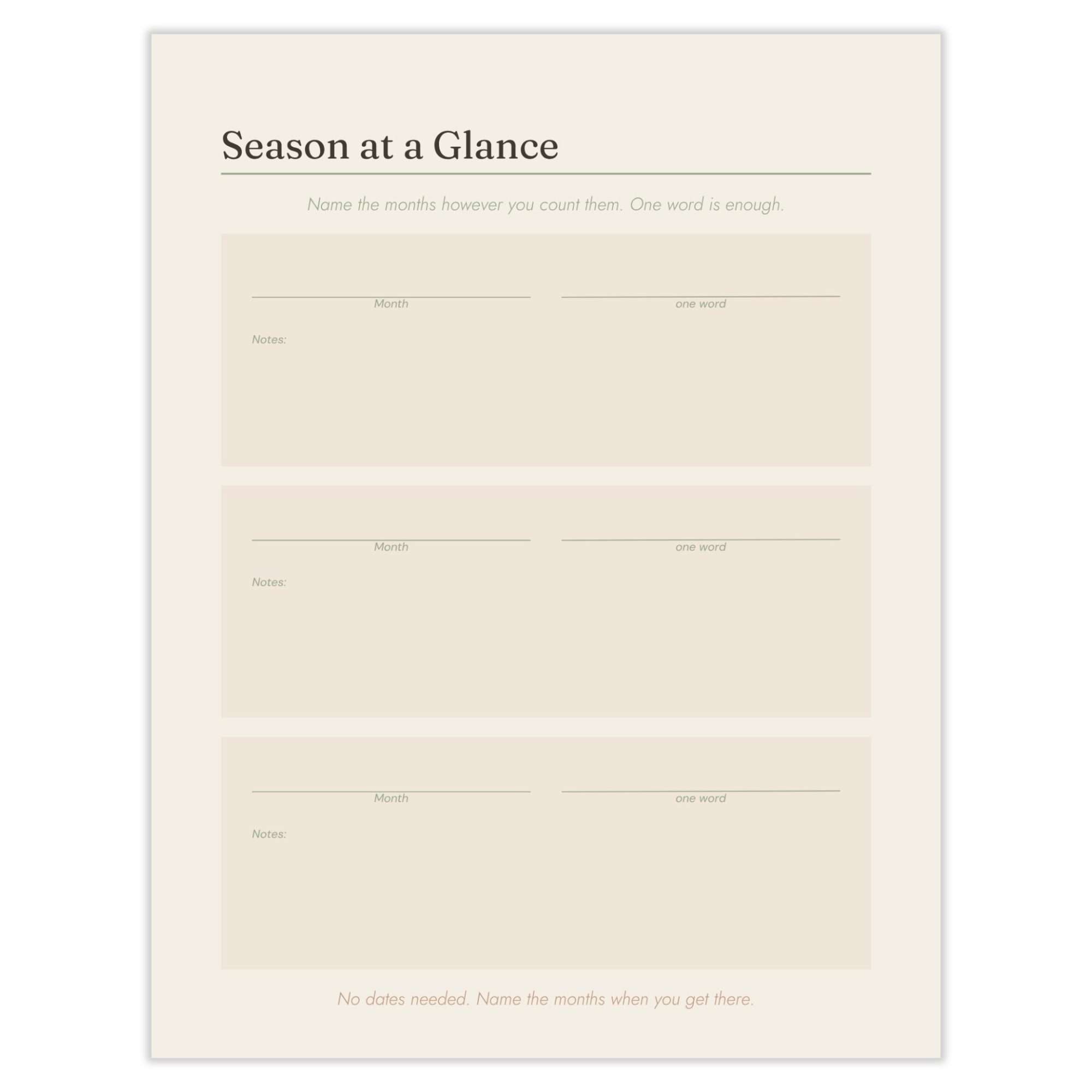
Planning this way keeps seasonal self-care flexible. If the season turns out heavier or lighter than expected, the plan bends with it instead of becoming one more thing you have fallen behind on.
Siding With the Light
You were never failing at routines. You were keeping faith with something older than routines — the same rhythm the trees are on. Building your care around it isn’t inconsistency. It’s alignment, and it’s much easier to sustain than perpetual summer. Seasonal self-care is just a name for honoring that.
A question to sit with, if you’d like one: What is this season quietly asking of me — and what am I still trying to carry over from the last one?

And if a small companion would help, A Gentle Season, an undated planner for planning a season at the capacity you actually have, lives quietly on Gumroad, with more gentle tools in the Etsy shop. No pressure and no timeline attached — it’ll be there whenever you’re ready.