Nourishing Your Body with Simple Self-Care Nutrition Habits
Let’s begin with what this isn’t.
This isn’t a plan. There are no macros here, no clean weeks, no lists of foods with moral alignments. If you arrived braced for rules, you can put that down — this corner of the internet doesn’t do food guilt.
What this is: a gentler question. Not “am I eating correctly?” but “am I feeding myself like someone I’m taking care of?” Because somewhere between the busy days and the complicated relationship most of us have with food advice, feeding yourself can quietly slip from care to logistics to afterthought. And the way back isn’t discipline. It’s a handful of small, kind habits. That, gently, is what self-care nutrition means here.
Hydration: The Unglamorous Foundation
Start with water, because it’s the highest-return, lowest-drama habit in the entire category. Hydration is the easiest place to begin self-care nutrition.
Mild dehydration doesn’t feel like thirst — it feels like fatigue, headache, fog, and a mysteriously short fuse. Many of the afternoons that get blamed on stress or character are, at least partly, a body running dry. (And thirst cues are unreliable narrators for many of us; by the time they speak up, you’re already behind.) MedlinePlus lists tiredness and dizziness among the common signs of dehydration, which is part of why it hides so well.
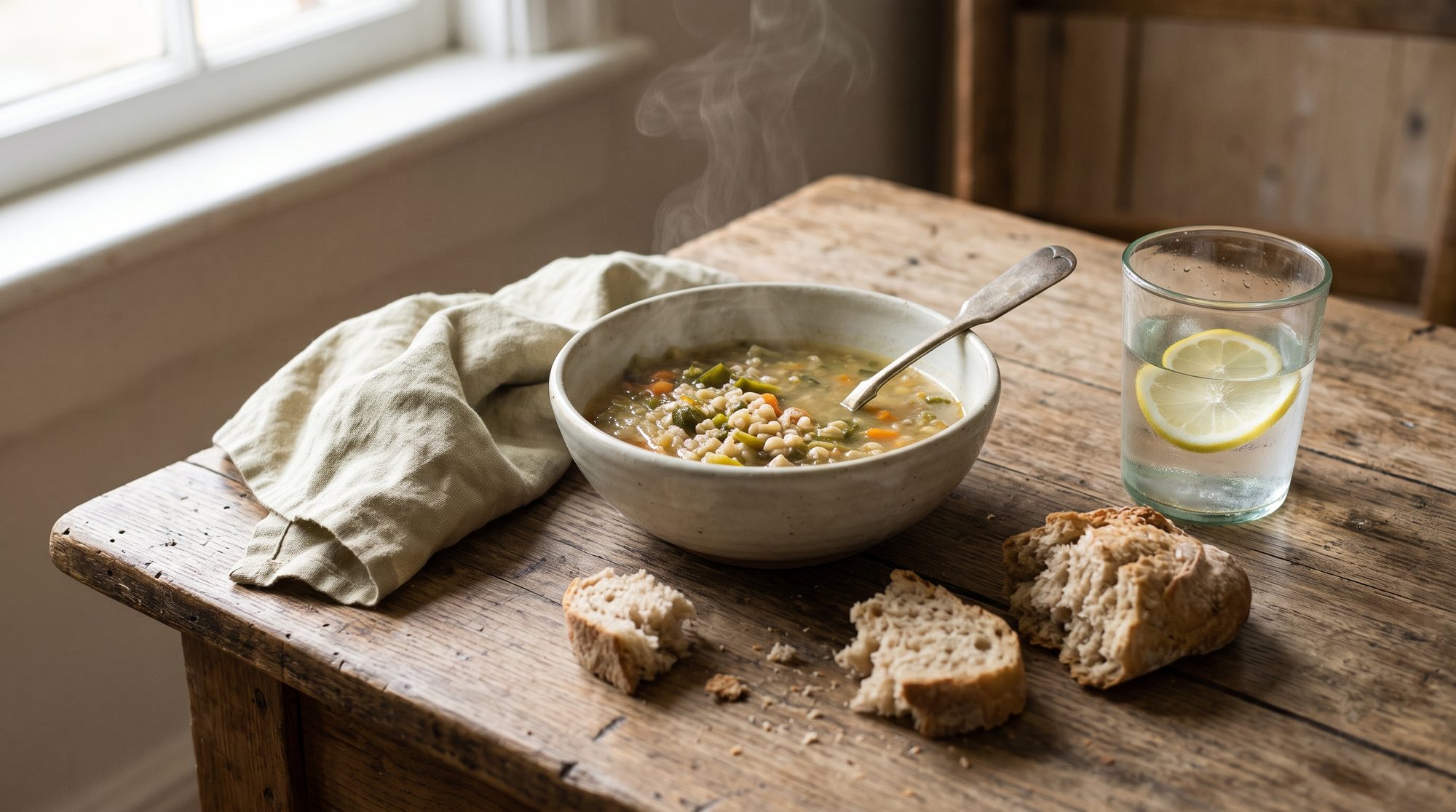
The kind approach is environmental, not disciplinary: a filled glass or bottle visible in every place you actually spend time — desk, couch-side, nightstand. A glass with the morning coffee, not instead of it. Something warm and non-caffeinated for the evening, because hydration is allowed to be cozy. If plain water bores you, it’s allowed to have lemon, mint, bubbles, or a splash of juice in it. Hydration has no purity requirements.
Making water rituals beautiful is not silly, either — the nice glass, the good mug, the pitcher with herbs in it. Beauty is how a habit earns affection instead of enforcement.
Self-Care Nutrition: Eating Like You’re on Your Own Side
The heart of gentle nutrition is a shift in stance: your body isn’t a project to manage. It’s a companion to feed. That shift is the core of self-care nutrition.
Regular beats optimal. A decent breakfast, an actual lunch, and an evening meal — kept boring and repeatable — do more for energy and mood than any elaborate protocol followed for nine days and abandoned. If deciding-what-to-eat is the barrier (it often is), a small rotation of three or four known meals per slot removes the decision without adding a rule. Consistency is the quiet engine of self-care nutrition.
Add before you subtract. Instead of taking things away — the classic first move of every food plan — start by gently adding: a piece of fruit that looked good, some protein at breakfast, the vegetables you actually like rather than the ones you think you’re supposed to like. Addition carries no failure state. There’s nothing to fall off of. Self-care nutrition grows by addition, not restriction.
Notice food-and-mood, without a verdict. Bodies have opinions: some meals leave you steady, some leave you crashed and craving a nap. Noticing these patterns — kindly, like a curious friend, maybe in a journal — builds the only nutrition knowledge that’s actually personalized. The rule is that it stays observational. The moment noticing becomes scoring, put the pencil down. If hunger and fullness signals are hard to read in the first place, Interoception and the ND Body explains why.
Eat with some attention, when you can. Not mindful-eating-as-performance — just, occasionally, tasting the food. Sitting down for one meal a day, phone elsewhere, counts as a complete practice. Attention is where satisfaction lives, and satisfied bodies ask for less emergency snacking later.
And keep the safety net honest. Some days are cereal-for-dinner days, toast-counts-as-a-meal days, whatever-is-in-the-freezer days. Those days are part of a working system, not a breach of it. Fed is always the baseline win — the fancier stuff is decoration on top of fed.
When Your Body Has Opinions About Texture and Smell
For a lot of us, food isn’t just a nutrition question — it’s a sensory one. Certain textures make eating feel genuinely unpleasant instead of neutral. Certain smells travel across a room and end an appetite before it started. Certain combinations on a plate — foods touching, sauces where you didn’t expect them — can turn a perfectly good meal into something you can’t sit with.
None of that is pickiness, and it isn’t something to argue yourself out of. A sensory system that reacts strongly to texture and smell is doing exactly what it’s built to do; it’s just calibrated more sensitively than the advice columns assume. The useful move isn’t forcing exposure until it stops bothering you. It’s building a rotation of foods your particular body actually tolerates well, and treating that rotation as complete rather than as a smaller, sadder version of “real” eating. For more on how sensory input adds up across a day, see Sensory Overload Is Real: How to Build a Personal Reset Kit.
Safe foods count. If there are three or four meals that never fail you — the same cereal, the same sandwich, the same bowl of noodles — those are not a failure of adventurousness. They’re infrastructure. A body that eats its safe foods consistently is doing better than a body that skips meals waiting for the energy to tolerate something harder. Safe foods are self-care nutrition, too.
New foods can wait for a good day. Trying something unfamiliar takes a kind of spare capacity that low-energy days simply don’t have. Saving experiments for the days you actually have room for them — rather than treating every meal as a chance to expand your palate — takes the pressure off the ordinary Tuesday dinner.
Smell matters as much as taste. If a food is fine cold but unbearable hot, or fine in one room but not another, that’s real information, not an inconsistency to explain away. Adjusting around it — eating near an open window, letting something cool first — is a reasonable accommodation, not a workaround to feel embarrassed about.
When Decision Fatigue Wins
Some days the barrier to eating isn’t hunger or appetite — it’s that deciding what to eat requires a kind of executive function that’s already spent on everything else. By six in the evening, the question “what do you want for dinner” can feel disproportionately enormous, and it’s common to sit with an empty stomach and a full fridge simply because choosing felt like too much. Why I Can’t Just Start looks at that same stuck feeling from another angle.
A few ways to lower that particular bar:
Pre-decide on a bad day, so you don’t have to decide on it. A short list, written when you have energy, of “emergency meals” that require zero thought when you don’t: the cereal, the frozen dumplings, the peanut butter toast. Keeping the ingredients stocked means the decision was already made by a version of you with more to work with.
Snack bags, assembled in advance. Ten minutes on a better day — portioning crackers, cutting fruit, filling small containers — buys several days of not having to make a food decision from scratch when you’re running low.
Let the freezer do the deciding. A stocked freezer of ready meals, homemade or store-bought, removes the “what do I make” question entirely on days that question feels unanswerable. This is not a lesser form of eating. It’s forethought, and forethought on a good day is one of the kindest things you can hand your future self.
The Quiet Extras
A few small habits with outsized returns, offered buffet-style — take one, ignore the rest: Each one is self-care nutrition at its smallest.
The 3 p.m. check. Afternoon crankiness is very often hunger or thirst in costume. One scheduled glance — when did I last eat or drink? — catches it before it runs the evening.
The gratitude seasoning. An occasional beat of noticing before or after eating — the smell of it, the warmth of it, the fact of it. Not a ritual with requirements; just the two-second version of this is care, and I did it for myself. For more small, no-pressure ways to notice the good, try Gratitude Journaling Without the Pressure.
The kind grocery note. One or two items each shop chosen purely because future-you will be glad: the soup for the fried day, the fruit that felt like summer. Groceries as tiny letters to the person you’ll be on Thursday.
The low-effort protein stash. Boiled eggs, string cheese, a tin of beans, a bag of nuts by the door — protein that needs no preparation tends to be the first thing skipped on hard days and the thing that would have helped most. Keeping some version of it visible and ready is quiet insurance against the afternoon crash.
Feeding a Body That’s Also a Nervous System
It’s worth naming plainly that eating and regulation are tangled together, not separate categories. A body that’s under-fed reads as more anxious, more reactive, more prone to spiraling over small things — not because the anxiety was imaginary, but because blood sugar and nervous system state share a lot of the same wiring. This isn’t a reason to police your eating more closely.
It’s the opposite: it’s permission to treat a snack as an actual intervention, not a minor thing you’ll get to later. If a hard emotional moment is also, quietly, a “haven’t eaten since breakfast” moment, addressing the second one sometimes does more for the first than any amount of thinking your way through it. On the days everything feels like too much, When Your Nervous System Is Fried offers a few no-pressure ways back down.
This also means the harshest days — the ones where cooking feels impossible and the fridge feels like a foreign country — are exactly the days nourishment matters most and is hardest to access. That’s not a contradiction to solve. It’s simply the reason the emergency list and the freezer stash exist: they’re built for the version of you who can’t make decisions right now, by the version of you who could. Self-care nutrition on those days is simply whatever gets food into you. If eating feels complicated in a deeper way, a doctor or registered dietitian, ideally one familiar with neurodivergence, can help.
A Few Micro-Steps (Pick One, Not All)
- Fill a glass now and put it where you’ll actually be for the next hour.
- Pick your three boring, repeatable lunches and write them somewhere visible.
- Add one thing to your next meal — fruit, protein, the vegetable you genuinely like.
- Try one phone-elsewhere meal this week and see what the food actually tasted like.
Fed Is the Baseline Win
Nourishment was never supposed to be a performance review. It’s one of the oldest forms of care there is — and offering it to yourself, imperfectly and daily, in whatever form today allows, is the entire practice. That is all self-care nutrition has to be.
A question to sit with, if you’d like one: If I fed myself the way I’d feed someone I love — no rules, just care — what would tomorrow’s first meal look like?
And if a small companion would help, the Eden’s Corner shop — gentle prompts and printable tools for days like this — lives quietly on Etsy and Gumroad. No pressure and no timeline attached — it’ll be there whenever you’re ready.