
Time Blindness Is Not a Character Flaw: A Gentler Way to Relate to Time
There are, as far as many ADHD brains are concerned, exactly two units of time: now and not now.
The dentist appointment on Thursday? Not now — functionally as distant as retirement. The five minutes you had before leaving the house? Somehow both plenty of time to start reorganizing a drawer and, simultaneously, already over. The “quick shower” that consumed forty minutes? News to you.
If you’ve spent your life being called careless, rude, or self-absorbed because of time blindness — while privately trying harder at punctuality than anyone around you — this one’s for you.
What Time Blindness Actually Is
Time blindness is a genuine difference in time perception, well documented in ADHD research and familiar across the ND spectrum. The internal clock most people consult unconsciously — the one that whispers about twenty minutes have passed — runs quietly, unreliably, or not at all.
It shows up as: difficulty feeling durations (one absorbing hour and one boring hour report identical readings of “???”), trouble estimating how long tasks take (everything is “twenty minutes,” including things that have never once taken twenty minutes), the future arriving in two flavors only (now and not-now, with deadlines teleporting from irrelevant to emergency), and losing time entirely inside absorbing tasks — hyperfocus being the deluxe version.
None of that is a decision. You can’t consult a clock you weren’t issued. And decades of “you just don’t respect other people’s time” lands hard on a person who has, in fact, been white-knuckling time harder than anyone.
Why Ordinary Time Tools Keep Failing
Planners, calendars, and stern resolutions all share one assumption that doesn’t hold up against time blindness: that seeing time written down converts into feeling it. For ND brains, it mostly doesn’t.
A 3 p.m. appointment written in a planner is information. It isn’t sensation. Until time becomes something the body can perceive — visible, audible, physical — the internal clock keeps reporting “not now” right up until it’s suddenly, catastrophically “now.”
So the workable approach isn’t more discipline with the same tools. It’s externalizing time — moving the clock from inside your head (where the equipment is spotty) to outside where your senses can reach it.
Making Time Blindness Visible, Audible, Physical
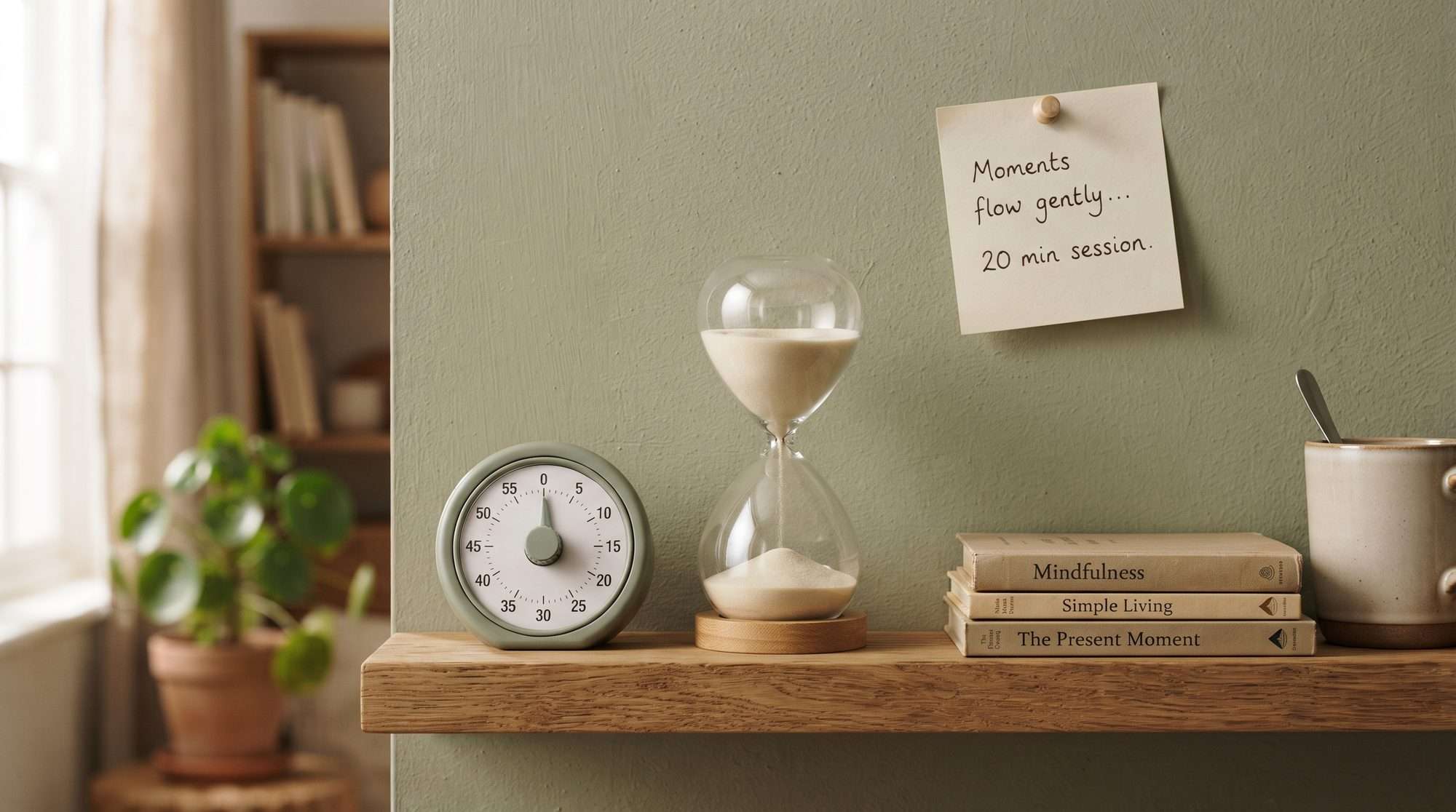
Visual timers. Analog-style timers where a colored disk shrinks as time passes (the Time Timer is the famous one, but any version works) turn duration into something the eye can watch. Time you can see is time you can feel. This one tool changes lives; there’s a reason every ND corner of the internet recommends it.
Alarms with names. Not one alarm — a sequence, labeled with actions: “start wrapping up,” “shoes on,” “leave now, not one more thing.” The last label matters — a “one more thing” clause is how five minutes disappears.
Body-based anchors. Attach times to physical routines instead of numbers: after the first coffee, meds; when the afternoon slump hits, the daily walk. Bodies keep rhythm better than they read clocks.
Time-tape the classics. Actually time your shower, your commute, your “quick” email check — once, out of curiosity, not judgment. Write the real numbers where you’ll see them. (“Shower: 35 min. Yes, really.”) Estimating from data beats estimating from optimism.
Backwards planning, one hop at a time. “Leave at 2:15” is abstract. “Out the door 2:15 → shoes 2:10 → stop what I’m doing 2:00” gives now-brain a chain of concrete nexts.
The Overestimate/Underestimate Trap
There’s a strange asymmetry to ND time perception that makes it even more disorienting: the same brain that underestimates how long a shower takes will often overestimate how long a dreaded task takes, by a wide margin. Cleaning the kitchen gets mentally filed as an hour-long ordeal; it’s actually twelve minutes. The email you’ve been avoiding for three days takes ninety seconds to write once you sit down.
This isn’t a contradiction — it’s the same unreliable internal clock, just distorted in the direction that avoidance benefits from. Dread inflates duration. Interest deflates it. Which means the number your brain hands you before starting something is rarely trustworthy in either direction, and treating it as data rather than feeling is its own small skill worth building.
A useful habit: when a task feels enormous before you start, ask “would I bet money this actually takes as long as it feels like it will?” Often the honest answer is no — and that tiny doubt is sometimes enough to get a foot in the door on something that’s been avoided for days purely because of a wildly inflated time estimate.
Time Blindness in Relationships and at Work
Time blindness doesn’t stay contained to solo tasks — it ripples outward into every context where other people are also tracking a clock. Meetings you’re late to. Messages that took “just a second” to answer, three days later. Plans made with genuine intention that quietly evaporate the moment they’re not in front of you.
At work, this often means building your own scaffolding rather than relying on institutional goodwill: calendar reminders with generous lead time, meetings you set an alarm for fifteen minutes early instead of at the start time, a habit of writing down commitments the second they’re made instead of trusting you’ll remember them when “later” becomes “now.” None of this is about looking more organized for an audience — it’s about closing the gap between your intentions, which are usually excellent, and your execution, which needs a little scaffolding to catch up.
In relationships, the repair usually isn’t a system at all — it’s a conversation. Most people can hold a lot of grace for lateness or slow replies once they understand it’s a wiring issue and not a message about their importance to you. What tends to actually damage relationships isn’t the time blindness itself; it’s the absence of any explanation, which leaves people to invent their own — usually a less generous one than the truth.
When the Guilt Shows Up as Overcorrection
For some people, the response to years of being called unreliable isn’t looseness with time — it’s the opposite. A hypervigilant relationship with the clock, arriving absurdly early to everything, running on a constant low simmer of time-anxiety, refusing to relax until an obligation is fully behind you. This is exhausting in its own way, and it deserves acknowledgment too: overcorrecting for time blindness is still time blindness, just wearing anxiety instead of lateness.
If this is your pattern, the tools above still apply — externalizing time reduces the need for constant internal vigilance either way. The goal isn’t precision. It’s enough structure that your nervous system can finally stand down from doing the clock’s job manually, all day, every day.
Letting Go of the Guilt (the Actual Hard Part)
The tools help. But the heavier work is retiring the story that came with the lateness — that you’re careless, disrespectful, bad at adulthood.
Consider the actual evidence: you’ve likely spent years building elaborate compensations, arriving anxious and over-apologizing, carrying a running dread about time that punctual people never feel. That’s not someone who doesn’t care. That’s someone playing a rigged game with real effort.
You’re allowed to tell people, plainly: “I have time blindness — it’s an ADHD thing. I use alarms and buffers, and I’m genuinely trying. If I’m running behind, it’s never a statement about how much you matter.” The people worth keeping tend to soften. And you’re allowed to extend yourself the same understanding you’d hand a friend with the same wiring — because “trying harder” was never the missing ingredient. Different tools were.
Building a Relationship with Time, Not a War Against It
It helps to stop framing this as a battle to win. You are not going to out-discipline a perception difference, the same way you couldn’t out-discipline colorblindness. What you can do is build a relationship with time that accounts for how your particular brain actually receives it — full of external scaffolding, low on shame, generous with buffers.
That relationship will look different depending on the week. Some weeks the alarms work beautifully and you arrive places with minutes to spare, faintly amazed at yourself. Other weeks the whole system falls apart and you’re back to the old scramble, the old apology, the old flush of embarrassment. Neither week is proof of anything permanent. Time blindness is a feature, not a referendum on your character, and a bad week with it says nothing about whether the tools are working — it just means this particular week needed more support than it got.
A Few Micro-Steps (Pick One, Not All)
- Time one “quick” routine this week — shower, coffee run, email check — and write down the real number.
- Rename tomorrow’s alarms with actions: “shoes on,” “leave now, not one more thing.”
- Put one visual timer in the room where time disappears most.
- Retire one guilt phrase (“I’m the worst”) and replace it with the accurate one (“my clock runs internal-only”).
A Friendlier Arrangement
You and time may never be close friends. A respectful working relationship — externalized, labeled, body-anchored, guilt-free — is entirely available.
A question to sit with, if you’d like one: Where does time disappear on me most — and what would it look like to make time visible there, instead of blaming myself in the dark?
And if a small companion would help, the Permission to Pause card deck — forty gentle prompts for stepping off the clock without shame — lives quietly in the Etsy and on Gumroad. No pressure and no timeline attached — it’ll be there whenever you’re ready.