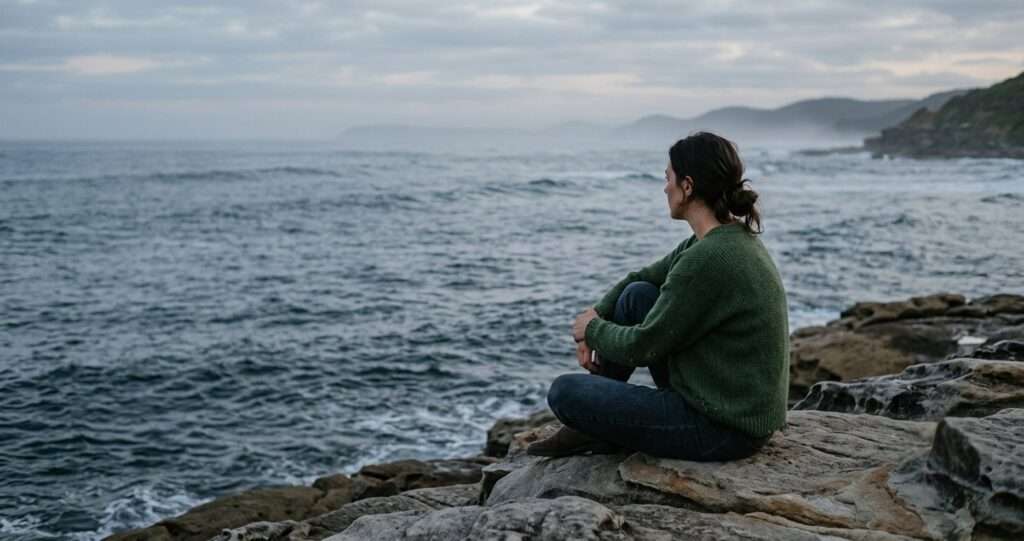

When You Feel Like You’re Floating Through Your Days
There are mornings when you open your eyes and already sense the distance. The light is the same. The room is the same. But you feel as though you’ve arrived in your life a few moments too late — or perhaps a few moments too early. Your feet find the floor, your hands find the familiar objects, and still, something in you hovers just out of reach.
You don’t have to name what pulled you away. It could be the weight of too many open tabs in your mind, the echo of a conversation that didn’t land the way you hoped, or simply the accumulated tiredness that no single night of sleep seems to touch. Whatever the reason, the feeling is the same: you are here, and also not quite here.
This isn’t a failure of mindfulness or a sign that you’re falling behind. It’s a human response to living in a world that often asks us to be everywhere at once. The nervous system learns to protect itself by stepping back when staying fully present feels like too much. That protection, while once necessary, can leave us feeling untethered in our own lives.
The Body’s Quiet Signals
Your body rarely goes silent, even when your attention is elsewhere. It speaks in the tension that settles between your shoulder blades by mid-afternoon. In the way your jaw tightens without you realizing. In the shallow, quick breaths that have become your default rhythm. Sometimes it’s smaller than that even — a faint pressure behind the eyes, the specific fatigue of hands that have been holding a phone too tightly, a swallow that catches on nothing in particular.
These aren’t symptoms to analyze or problems to solve. They’re simply information — the body’s way of saying, I’m still here. I’m carrying what you’ve asked me to carry. And I would like to share the load.
There is no requirement that you resolve these signals or turn them into a project. Sometimes the most radical act of care is to notice them without immediately trying to change them. To let the noticing itself be the beginning of coming home.
You might find that your body has its own preferred ways of asking for attention. A sudden restlessness in your legs. A heaviness in your chest that doesn’t quite match the moment. A feeling of being slightly behind your own eyes. These signals aren’t interruptions to your day. They are the day, trying to include all of you.
Small Anchors in Ordinary Moments
Returning to yourself doesn’t need to look impressive. It doesn’t need to happen in a dedicated corner with special cushions or timed sessions. It can happen in the middle of ordinary life, in the spaces between tasks.
It might look like pausing before you reach for your phone and instead feeling the texture of the table under your fingertips. It might be the decision to stand up and stretch, not from obligation, but because your body asked for movement. It might be three breaths taken while the kettle boils — breaths where you let the exhale last a little longer than the inhale, and notice what that does to the tightness in your chest. It might even be something as small as noticing the temperature of the doorknob under your palm as you walk from one room to another — a detail so ordinary your mind usually edits it out entirely.
These moments don’t accumulate into some perfect state of presence. They simply remind you, again and again, that you have not been abandoned by your own life. The ground is still beneath you. The breath is still moving through you. The moment is still willing to receive you, exactly as you are.
You might find that certain anchors feel more accessible than others. For some, it’s the feel of bare feet on cool floorboards. For others, it’s the sound of their own name spoken softly in their mind, or the sight of a plant on the windowsill that has continued growing without any help from them. There is no right way to land. Only the ways that feel possible today.
Some days the anchor might be as simple as placing both hands on your lap and feeling their weight. Or stepping outside for the length of one slow breath and letting the air touch your face. These are not practices to master. They are lifelines you can reach for when the current feels strong.
Letting the Return Be Imperfect
Some days the return will be brief — a single conscious breath before the mind wanders again. Other days it might stretch into a longer stretch of noticing. Both are complete in themselves. Neither is better than the other.
The practice, if we can call it that, is not about lengthening the time you spend present. It’s about shortening the time you spend believing you’ve failed when you drift. To catch yourself floating and think, with something like kindness, Ah, there I go again. And here I am, still able to notice.
Nature offers us this lesson constantly. A tree doesn’t apologize when the wind bends its branches. It doesn’t try to force itself back to perfect stillness. It simply moves with what is, roots holding firm even when the visible parts sway. We are allowed the same grace.
You are allowed to be a work in progress. You are allowed to need reminders, again and again, that you are safe to land. You are allowed to come back in pieces, in fragments, in moments so small they might not seem worth counting. They are.
There is no prize for how quickly or completely you return. The only invitation is to notice when you’ve drifted and to offer yourself the grace of beginning again, without the story that you ever truly left.
A Soft Place to Rest
If today all you can manage is to notice the distance and wish, very quietly, that it were smaller — that is already an act of coming home. The wish itself is a thread. And threads can be followed whenever you have the capacity to follow them.
There is no rush. There is no test. There is only this moment, and the next, and the quiet fact that something steady has been holding you all along.
The ground beneath you has not moved. Your breath has not abandoned you. And you, in all your floating and returning, are still exactly where you need to be — even when it doesn’t feel that way yet.
If This Found You Gently
If this found you on one of your floating days, the Root & Rise affirmation cards were made for exactly this kind of return.